Meeting notes
Decisions, owners, blockers, and next actions for team follow-up.
Flagship lane
img-summary helps Hermes prepare image-generation
prompt cards for meeting notes, reports, GitHub PRs, issues,
research briefings, and release updates. OMH shapes the card before
a connected image tool runs. The card keeps a stable OMH generated
mark and evidence footer, while three layers change independently:
source kind defines the content structure, domain defines the
scene and materials with an explainable domain_key, and
poster_archetype/v1 defines the design grammar. Security can use cinematic key art, sports can use event
poster motion over real court or track texture, commerce can use
product-ad staging, and fashion can use luxury lookbook spacing,
fabric, runway, and magazine-paper depth. OMH then records image
generation, visual QA, attachment, and delivery only when those
events are observed. If no generator is connected yet, Hermes can
first choose a GPT image tool, an existing Hermes connector, a
generic image tool, or prompt-only mode.
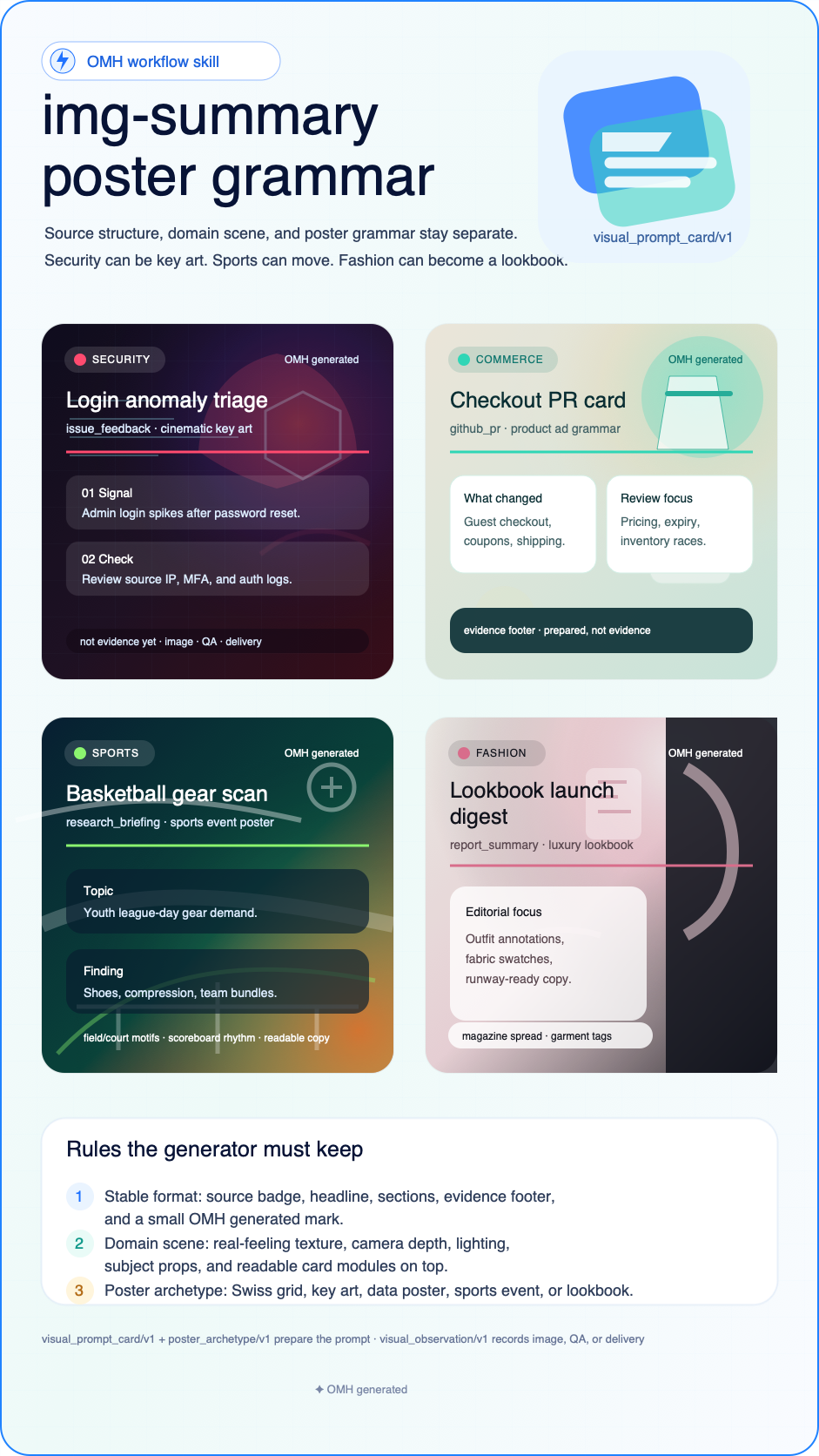
The visual system is not one fixed grid. OMH selects a visual format
and aspect ratio that match the source, then adds a detected visual
domain_key for premium background plate, material texture, camera
treatment, lighting, motifs, palette, and composition. A separate
poster archetype controls the poster grammar, such as Swiss grid,
cinematic key art, editorial magazine, data infographic, product ad,
technical brutalist, sports event, or luxury lookbook. The shared proof structure stays
stable: source badge, headline, readable modules, evidence footer,
and the small OMH generated mark.
Decisions, owners, blockers, and next actions for team follow-up.
Long-scroll digest cards for metrics, observations, caveats, and actions.
What changed, risk, tests, reviewers, and merge readiness for sharing.
Signal, severity, reproduction path, owner, and triage decision.
Findings, source quality, disagreement, caveats, and what to verify.
What is new, who should care, upgrade notes, and confidence level.
Security, commerce, sports, fashion, finance, developer, and research prompts get different scenery, texture, lighting, and motifs.
Swiss grid, cinematic key art, product ad, technical brutalist, sports event, and luxury lookbook styles change composition, type, texture, and visual pacing.
Hermes can use this lane when a chat summary needs to become a shareable visual. The wrapper can show the prompt card, copy the prompt into an already connected image tool, or fall back to image_generation_setup/v1 before generation, then record what happened back into OMH.
Normal users should ask Hermes for the card in chat. Operators and wrappers can call the deterministic backend to preview the exact contract shape without contacting an image provider.
omh img-summary prompt-card --kind github_pr --section summary:What_changed:Setup_copy_now_matches_the_site
omh img-summary prompt-card --kind report --section summary:Executive_summary:Weekly_metrics_changed
omh img-summary observe --card-id <id> --type generated_image_observed --path ./card.png --summary "Generated with connected image tool"
The first two commands prepare visual_prompt_card/v1.
If no image tool is connected, the card also carries
image_generation_setup/v1 so Hermes can ask what to use
before generation. They are not generated image evidence. The
observation command records one explicit event after the external
image step actually happens.