QoS Classes
When a Kubernetes node runs low on memory resources, it needs to perform tasks such as terminating certain Pods or processes and reallocating resources to other Pods.
So, what criteria are used for this reallocation? Let's explore these criteria.
Kubernetes OOM #
Before diving into that, let's understand Kubernetes OOM (Out of Memory).
kubectl describe nodes {node_name} | grep -A9 Conditions
Each Kubernetes node has "conditions" that contain information about the node's abnormal states.
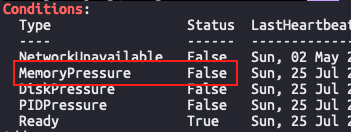
MemoryPressure is fundamentally designed in Kubelet to occur when available memory falls below 100Mi.
When MemoryPressure occurs, Kubelet prioritizes all Pods running on that node and evicts the Pods with the lowest priority.
Furthermore, no more Pods are scheduled to nodes where MemoryPressure is True. At this point, Pod priority is determined by sorting based on QoS class and memory usage.
QoS Classes #
Kubernetes assigns a QoS class to a Pod based on its Request and Limit settings.
There are three QoS classes: BestEffort, Burstable, and Guaranteed.
BestEffort #
apiVersion: v1
kind: Pod
metadata:
	name: nginx-besteffort-pod
spec:
.   containers:
	- name: nginx-besteffort-pod
	- image: nginx:latest
As shown above, a Pod becomes BestEffort when the resources section (request, limit) is not used.
kubectl describe pod nginx-besteffort-pod | grep QoS

If the resources section is not used as above, there are no resource limits, and if idle resources exist, the Pod can use all resources without restriction.
And since no request is set, there are no guaranteed resources.
This means that, depending on the situation, it might use all available resources on the node, or it might not be able to use any resources at all.
BestEffort Pods are the first to have their resources reclaimed if an OOM event occurs on the node.
Guaranteed #
apiVersion: v1
kind: Pod
metadata:
	name: nginx-guaranteed-pod
spec:
	containers:
	- name: nginx-guaranteed-pod
	- image: nginx:latest
	resources:
		limits:
			memory: "256Mi"
			cpu: "1000m"
		requests:
			memory: "256Mi"
			cpu: "1000m"
As in the YAML file above, if the limit and request values are equal, the Pod is assigned the Guaranteed class.
kubectl describe pod nginx-guaranteed | grep QoS
Since the Pod's request and limit are equal, overcommit is not allowed, and resource usage is guaranteed to be limited.
- All processes running within a Guaranteed class Pod have their default OOM score (oom_score_adj) set to -998.
- If a Pod contains multiple containers, all containers must have identical Request and Limit settings to be classified as Guaranteed.
Burstable #
apiVersion: v1
kind: Pod
metadata:
	name: nginx-burstable-pod
spec:
	containers:
	- name: nginx-burstable-pod
	- image: nginx:latest
	resources:
		limits:
			memory: "1024Mi"
			cpu: "1000m"
		requests:
			memory: "256Mi"
			cpu: "500m"
kubectl describe pod nginx-burstable | grep QoS
As in the YAML file above, a Pod is Burstable when the limit is greater than the request (or if not all containers have identical request/limit settings in a multi-container Pod).
Simply put, it means that the Pod can use the requested resources, but can use up to the limit if the situation allows.
Priority #
As mentioned at the very beginning, Pods are managed according to their priority.
So, what is the priority order among the three QoS classes?
Typically, it's Guaranteed > Burstable > BestEffort.
"Typically?" implies there are exceptions. Sometimes, the priority between Burstable and BestEffort can change based on memory usage. (That is, the more memory a Pod uses, the lower its priority.)
[[Pod LifeCycle(Phase, Condition)]]