Node Components
Let's learn more about them this time.
Node components refer to the elements required to run and manage pods and containers on each node.
They exist not only on worker nodes but also on master nodes.
Control plane components, which are necessary for cluster control, also run as individual pods, so a tool to manage them is needed.
kubelet #
It is an agent that orchestrates containers within pods to run correctly on each node of the cluster.
When the master node's scheduler assigns a pod to a node, kubelet ultimately places the containers for that pod.
It also periodically checks the status of pods and containers and sends the results to the API server.
When building a cluster with kubeadm, kubelet is not included, so it must be installed separately, and the versions of kubeadm, kubectl, and kubelet must be matched to avoid compatibility issues.
kube-proxy #
It is Kubernetes' network proxy that runs on each node of the cluster.
It creates and manages rules for forwarding internal/external traffic, which comes into an object called Service in Kubernetes, to which pod.
For this purpose, kubeadm deploys one kube-proxy pod as a DaemonSet on every node, and this information can be checked using the kubectl get daemonset -n kube-system command.
Kubernetes pods are ephemeral, so node IPs constantly change. Therefore, to ensure inter-pod networking in such an environment, Services are used.
A Service is a virtual component that exposes applications running through pods to the network.
A Service has no concrete entity like a pod or container; it only performs network relaying between pods.
It can be seen as an implementation of a proxy that manages the list of nodes/pods and forwards traffic to the necessary destination.
For this, a Service also receives an internal IP from the cluster and acts as a gateway responsible for connections between pods.
The process that enables pods to access a Service performing the above role is kube-proxy.
The detailed role of kube-proxy has changed significantly around Kubernetes version 1.20. Previously, kube-proxy directly performed the user space proxy role, but more recently, it only manages and manipulates netfilter via iptables.
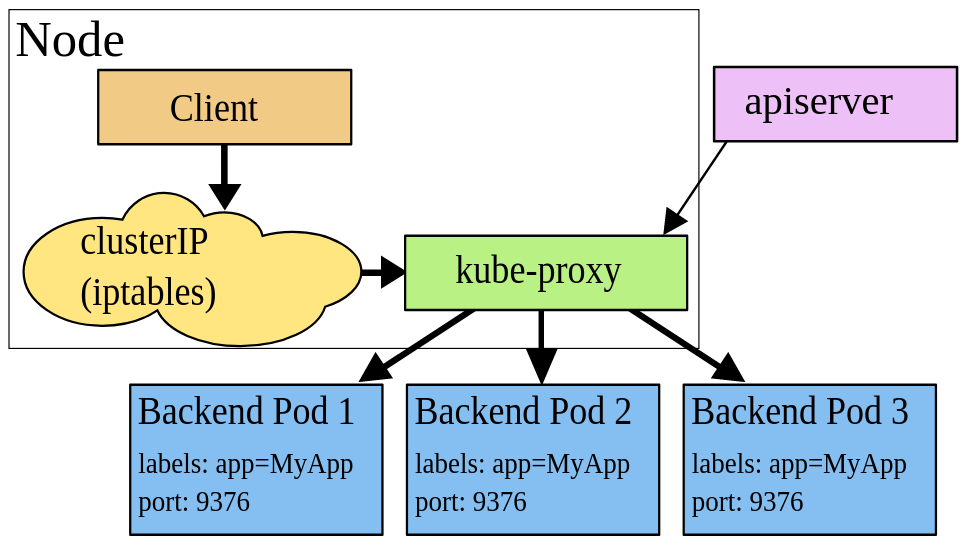
Case 1 - user space proxy role (before 1.20) #
Let's assume a specific client process sent an access request targeting 10.3.241.152:80, which was then sent to the pod's veth0 at 10.0.2.3.
- kube-proxy opens port 10400 (arbitrary) on the localhost interface to receive service requests.
- kube-proxy configures netfilter (in the physical server's kernel) to route packets arriving at the service IP (
10.3.241.152:80) to kube-proxy itself. - kube-proxy forwards the incoming request to the actual server pod
<IP:Port>(e.g.,10.0.2.2:8080).
In such a case, all pods in the cluster would call kube-proxy every time they request the Service's IP. This results in a heavy load on the host and consumes resources.
Case 2 - role of only manipulating netfilter via iptables (after 1.20) #
In this case, kube-proxy does not directly perform the proxy role but delegates it entirely to netfilter.
Netfilter handles all tasks of discovering the Service IP and delivering it to pods, while kube-proxy merely modifies netfilter's rules appropriately.
When changes occur in Kubernetes, such as creating a new Service, a pod being created, or a ReplicaSet changing, the corresponding resource controller becomes aware of it.
At this point, the controller informs kube-proxy of this information, and kube-proxy operates by dynamically delivering new traffic distribution rules to netfilter via the Linux tool iptables.
Container Runtime Engine #
The engine that fetches and runs container images within the cluster.
It is an essential component for pods to operate within a node.
As of Kubernetes version 1.23, the runtimes supported on Linux OS are as follows:
- containerd
- CRI-O
- Docker Engine (deprecated; scheduled for removal in
1.24) - Mirantis Container Runtime
Docker Engine Deprecation (after v1.24) #
Originally, Kubernetes supported Docker as the runtime engine for creating and running containers, but in December 2020, it announced that support would be deprecated after version 1.20. As of February 2022, runtime support using Docker is scheduled to be completely discontinued starting with the upcoming 1.24 version, and alternative solutions like containerd are now being used by default.
The exclusion of Docker from the runtime engine does not mean that Docker itself cannot be used in a Kubernetes cluster. It only means it is excluded from the runtime engines supported by Kubernetes. Images created with Docker follow the OCI (Open Container Initiative) standard, so they can still be run without issues via containerd and CRI-O, which is the official stance of The Linux Foundation.