Namespace, Container + runc syscall tracking
The official Docker documentation states that namespace = container.
What is a container? It's a containerization technology that allows you to create and use Linux containers, a software virtualization method that enables isolated execution on a shared operating system.
How does a container achieve virtualization? Why is it explained that container = namespace?
To put it simply, Docker provides an isolated space for containers using a technology called namespace.
It's okay if you don't understand. In fact, it's normal not to understand yet. Now, let's try to understand this statement.
volumes:
  wordpress:
    driver_opts:
      type: none
      o: bind
      device: /User/Khope/data/woredpress
  mariadb:
    driver_opts:
      type: none
      o: bind
      device: /User/Khope/data/mariadb
I've written a compose file that creates volumes mounted to my host space like this.
Now, if you type id, you'll see the khope (host) user and the ctr user for /data/mariadb (which maps to /var/lib/mysql).
Let's create a file in the container and check its owner. I created file.txt using touch and then ran ls -al | grep "file".
# /var/lib/mysql (in container)
$ ls -al | grep "file"
>> ctr              ctr

# ~/data/mysql
$ ls -al | grep "file"
>> khope              khope
As you can see, the user who grepped the file in the container and the user who grepped it on the host both claim to be its owner.
What if we check the process output using watch ps ax? You can also confirm that the same process has different PIDs in the container and on the host. (Try it yourself)
This clearly shows the difference between Docker and a virtual machine.
It's that the Host and Container share resources. And when we use them, we enable them to run without interference through a certain level of isolation. It is namespace that enables this functionality. To summarize, a certain level of isolation can be defined as a container, and an independent virtual space can be defined as a namespace.
I mentioned earlier that namespace = container, but more precisely, since a container operates within the space created by a namespace, it might be considered a dependent concept.
containerd #
If you look at the process tree structure with pstree, you can observe containerd, containerd-shim, etc., and you can see that watch is running by containerd-shim.
What is containerd here? It is a standard container runtime focused on simplicity and robustness for portability.
Haha, that's too difficult to understand. Simply put, it manages the entire container lifecycle on the host system.
containerd has very minimal runtime requirements, and most interactions with Linux containers are handled through runc.
Since too many concepts are coming up, let's ignore runc for now and briefly look at something simpler.
- docker build
- docker pull
- docker run
When you enter the commands above, they are passed to dockerd, and dockerd automatically (by default) starts containerd. (Although runc actually handles the practical container management.)
Ah, you might find the above sentence too difficult. That's because it contains information not covered in this article. Don't despair. Just know that these things exist.
cli <-> dockerd -> containerd -> runc is the communication structure.
When we type a CLI command, it communicates with dockerd. Since containerd manages and creates containers before dockerd starts, it is automatically executed first by dockerd. containerd then uses runc to actually create and run containers.
Let's dig a bit deeper. To view Docker logs, type strace -f -p $(pidof container) -o docker_log.txt. Using the above will trace the containerd process.
Next, let's create and run a new container using docker run -it --name debina debain:buster.
Then, a log file will be left with an "attached" message, and if you examine it, you can track syscalls.
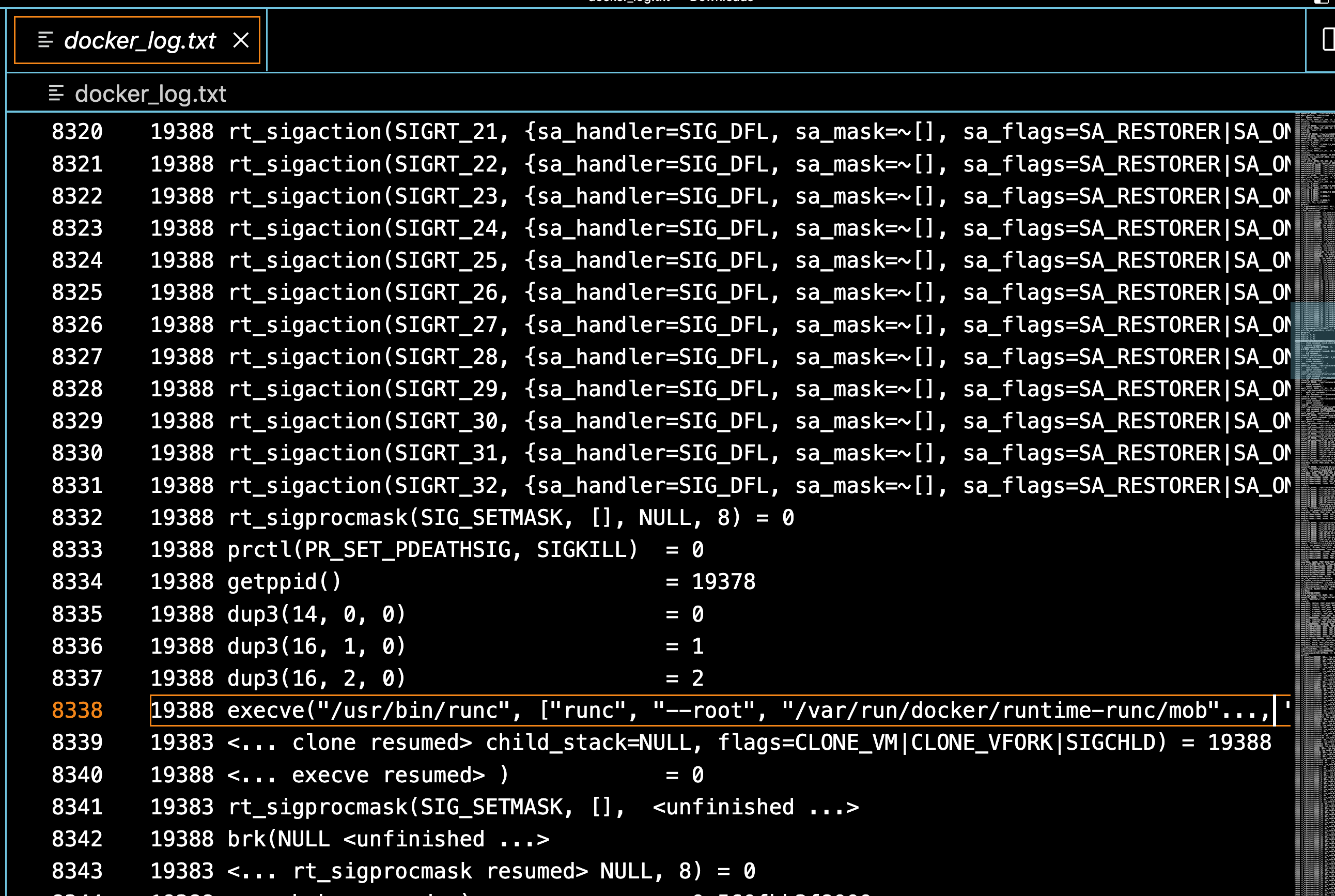
It looks roughly like this, and you can see runc being executed with the execve command. Let's look at the logs after runc is executed.
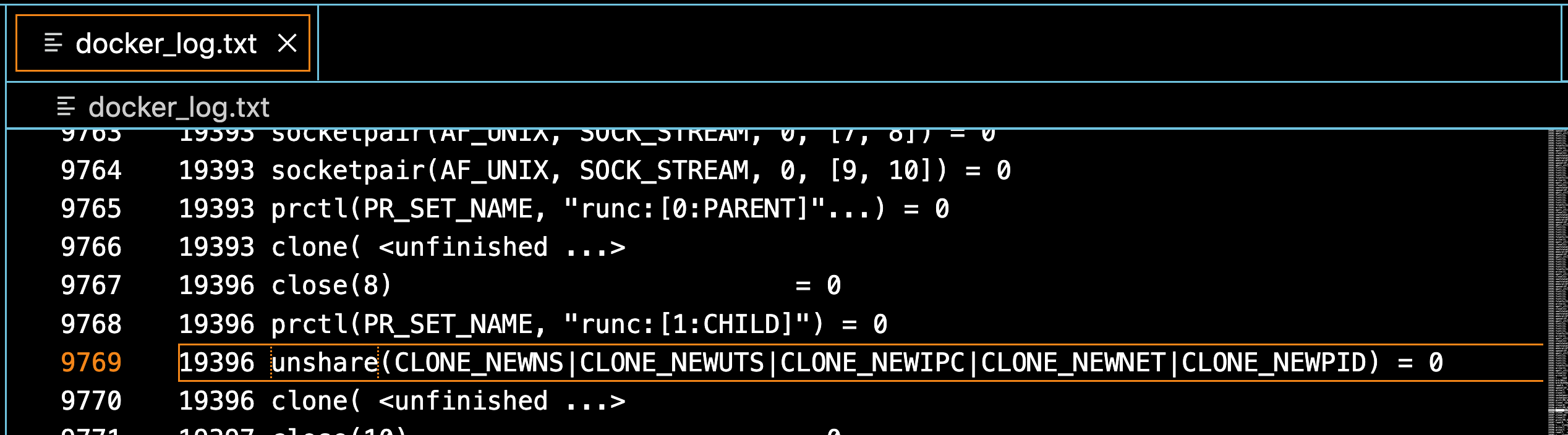
It calls a syscall called unshare. If you look at the line just above it, you'll see the command prctl(PR_SET_NAME "runc:[1:CHILD]") = 0. prctl is a command that manipulates a process's thread, and the PR_SET_NAME option is used to specify the name of the calling thread. However, I hadn't created a separate thread, so I looked it up to see if it creates one beforehand. It turns out that PR_SET_NAME can also change the process name, and if used within a process, the process name changes and its associated threads are affected. If called from a thread, only that thread's name changes.
Calling unshare here creates a new child process. There's also a CLONE_NEWPID option, which creates a new PID namespace (not shared with the calling process). The process that called unshare does not move into the new namespace, but the child created by the calling process is reflected to act as init(1) in the new namespace.
In short, it creates a new process and forks it from the parent process.
This is cool, so I'll include an English document. -> https://man7.org/linux/man-pages/man2/unshare.2.html
To summarize, a container is an isolated space from a namespace, runc actually creates and manages containers, and a sub-thread of runc creates a new namespace through the unshare() syscall.