Template Method Pattern
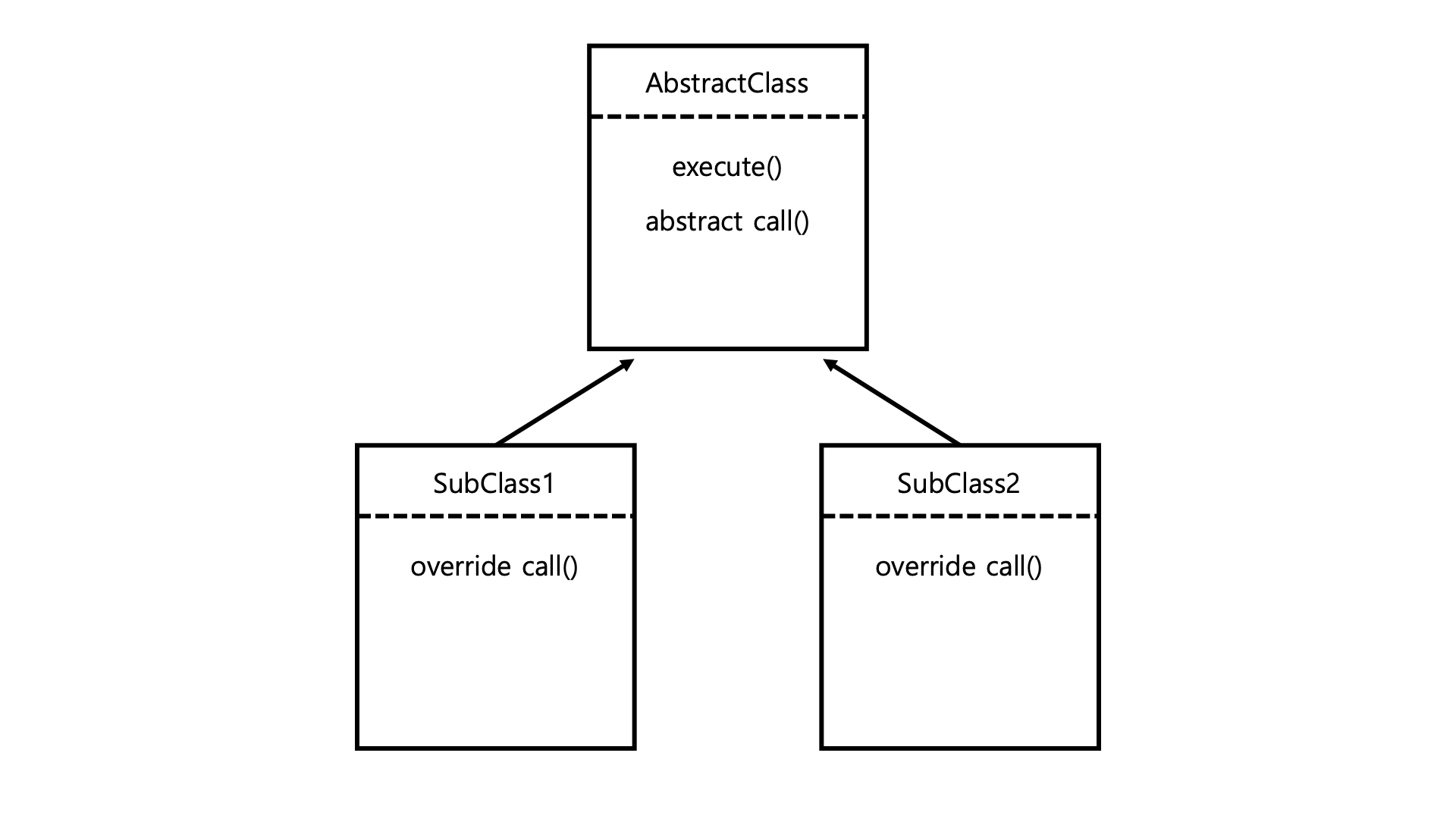
- When writing code, you often encounter repetitive code for things like logging, exception handling, etc.
- In such cases, the Template Method pattern is one of the patterns used to eliminate
code duplication. - The AbstractClass provides a template, and subclasses inheriting it implement the concrete logic.
- The abstract class defines the overall skeleton, and some logic is implemented in the inheriting subclasses.
- Duplicate logic is defined in the abstract class, and only the varying business logic is overridden in the inheriting classes.
- Here, duplicate logic can generally be considered the
unchanging part, and business logic thechanging part.
Example #
Let's write a simple example code.
- Business logic 1 exists
- Business logic 2 exists
- Common logic exists to measure the execution time of each business logic
Before #
public class BeforeTemplateMethodApp {

    public static void main(String[] args) {
        logic1();
        logic2();
    }

    private static void logic1() {
        StopWatch stopWatch = new StopWatch();
        stopWatch.start();

        // 비즈니스 로직 시작
        System.out.println("비즈니스 로직 1 실행");
        // 비즈니스 로직 종료

        stopWatch.stop();
        System.out.println("실행 시간 = " + stopWatch.getTotalTimeMillis());
    }

    private static void logic2() {
        StopWatch stopWatch = new StopWatch();
        stopWatch.start();

        // 비즈니스 로직 시작
        System.out.println("비즈니스 로직 2 실행");
        // 비즈니스 로직 종료

        stopWatch.stop();
        System.out.println("실행 시간 = " + stopWatch.getTotalTimeMillis());
    }
}
If we implement the requirements simply, common logic exists like this.
In the code above, the only differing part is business logic execution, and the rest is all duplicated code.
Let's refactor by applying the Template Method pattern.
Abstract Class #
public abstract class AbstractTemplate {

    public void execute() {
        StopWatch stopWatch = new StopWatch();
        stopWatch.start();

        // 비즈니스 로직 시작
        call();
        // 비즈니스 로직 종료

        stopWatch.stop();
        System.out.println("실행 시간 = " + stopWatch.getTotalTimeMillis());
    }

    protected abstract void call();
}
- This is an abstract class that holds common logic.
- Inside the
execute()method, the business logic part is replaced by a call to thecall()method. - The
call()method is overridden in child classes that inherit this abstract class.
Sub Class #
public class SubClassLogic1 extends AbstractTemplate {

    @Override
    protected void call() {
        System.out.println("비즈니스 로직 1 실행");
    }
}

public class SubClassLogic2 extends AbstractTemplate {

    @Override
    protected void call() {
        System.out.println("비즈니스 로직 2 실행");
    }
}
- These are SubClasses that inherit the abstract class.
- These are simple methods that only define business logic.
- If another business logic 3 is needed later, you can define and use SubClassLogic3.
Application (Client) #
public class AfterTemplateMethodApp {

    public static void main(String[] args) {
        AbstractTemplate template1 = new SubClassLogic1();
        template1.execute();

        AbstractTemplate template2 = new SubClassLogic2();
        template2.execute();
    }
}
This is the part where it's actually used.
Calling the execute() method is the same, but the logic changes depending on which object is created.
Pros and Cons #
- Pros
- Eliminates duplicate code and allows SubClasses to focus solely on business logic (SRP)
- If new business logic is added later, existing code does not need to be modified (OCP)
- Cons
- Requires continuous creation of class files
- Child classes have a dependency relationship due to inheritance solely for pattern implementation, even though they don't actually use the parent class
The Strategy pattern is a design pattern that performs a similar role to the Template Method pattern while eliminating the disadvantages of inheritance.