Mediator Pattern
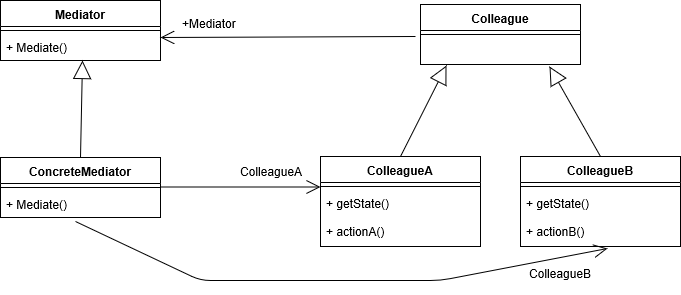
The Mediator pattern is a design pattern that allows for reduced interdependencies between components by entrusting their interactions to a mediator.
Example #
For example, let's say we have a Customer class, Restaurant, and TowelService.
A Customer can have dinner at the restaurant and receive a towel through the TowelService.
In that case, Customer would implement methods like getTowel and dinner by depending on those two classes, which increases coupling due to mutual dependency.
By introducing a FrontDesk mediator that takes the customer as an argument and processes tasks based on customer information using the restaurant and towelService, we can eliminate the dependency between the customer and other services.
Advantages #
An advantage is that it reduces mutual dependencies, allowing for the creation of loosely coupled code.
Even if many classes are introduced, the Client only needs to know about the mediator, making it easy to extend.
Disadvantages #
While it allows for easy extension and the creation of highly coupled class structures, one disadvantage is the complexity of the mediator class. This is because the mediator class holds all dependencies on related services.
However, when comparing this issue with the benefits gained from the Mediator pattern, I believe that using the Mediator pattern offers more advantages, making it a worthwhile pattern to apply.
Example in Spring #
In Spring, the DispatcherServlet (front controller) class is a prime example developed based on this pattern.
It acts as a mediator for requests and responses in Spring MVC, similar to handlerMapping.