Graph
A graph is a data structure that expresses the relationships between connected elements.
Concept of a Graph #
Simply a data structure that collects nodes and the edges connecting them.
- In other words, it's a data structure that can represent relationships between connected objects.
- e.g., maps, shortest paths in subway lines, components in electrical circuits, roads, prerequisite courses, etc.
- A graph can consist of multiple isolated subgraphs.
Reference #
- Eulerian Path
- Refers to a path that traverses every edge in a graph exactly once and returns to the starting vertex.
- An Eulerian path exists only when the number of edges connected to every vertex in the graph is even.
Graph-related Terms #
- Vertex: The concept of a location (same meaning as node)
- Edge: The relationship between locations; a line connecting nodes (also called link, branch)
- Adjacent Vertex: A vertex directly connected by an edge
- Degree of a Vertex: In an undirected graph, the number of vertices adjacent to a single vertex
- Sum of all degrees of vertices in an undirected graph = 2 * number of edges in the graph
- In-degree: In a directed graph, the number of incoming edges from outside
- Out-degree: In a directed graph, the number of outgoing edges
- Sum of in-degrees or out-degrees of vertices in a directed graph = number of edges in the directed graph
- Path Length: The number of edges used to form a path
- Simple Path: A path where no vertex is repeated
- Cycle: A simple path where the starting and ending vertices are the same
Characteristics of a Graph #
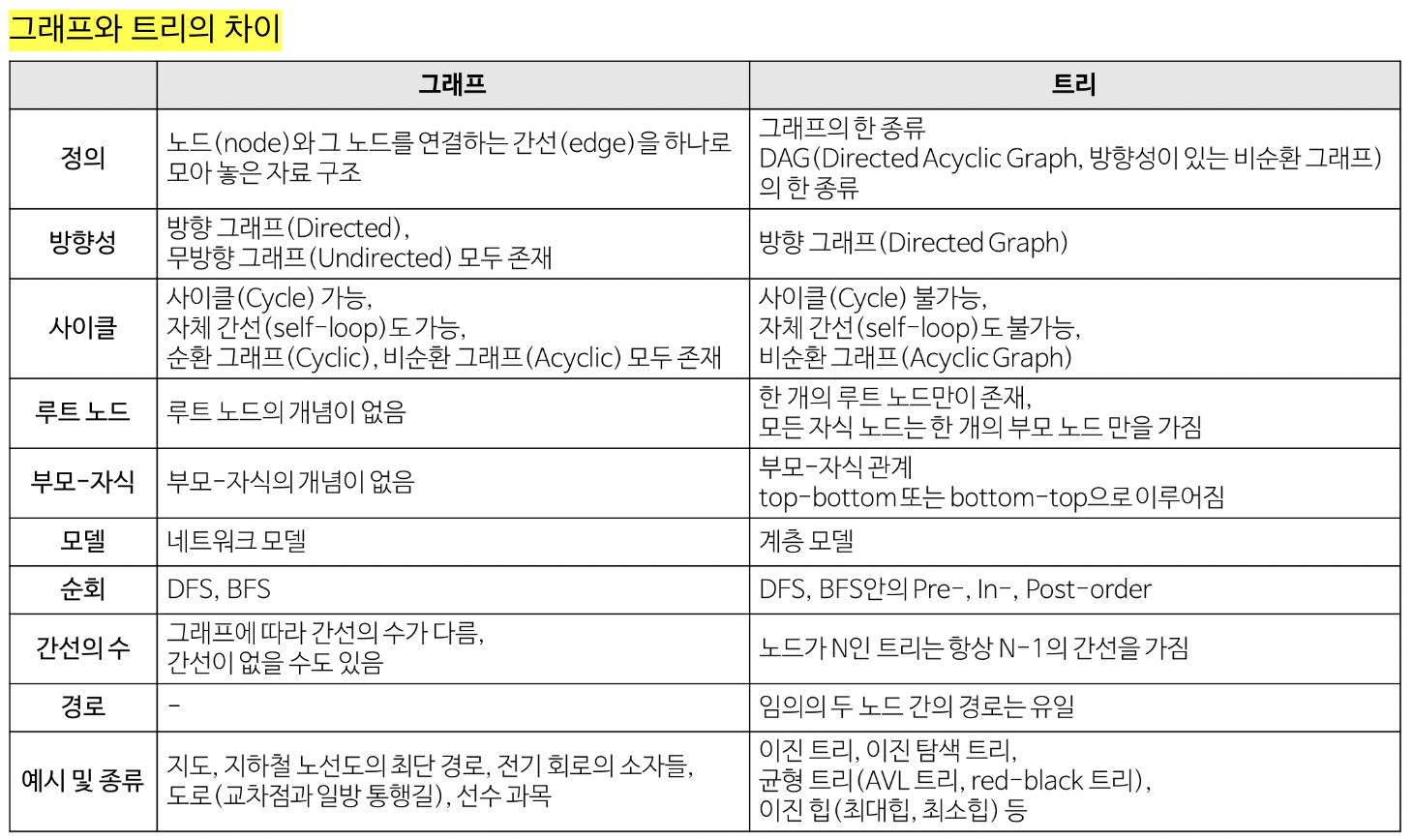
- A graph is a network model.
- Two or more paths are possible.
- That is, nodes can have bidirectional paths in undirected/directed graphs.
- Both self-loops and general loops/circuits are possible.
- There is no concept of a root node.
- There is no concept of a parent-child relationship.
- Traversal is performed using DFS and BFS.
- A graph is either cyclic or acyclic.
- Graphs are broadly categorized into directed graphs and undirected graphs.
- The presence or absence of edges varies depending on the graph.
Types of Graphs #
Undirected vs. Directed #
- Undirected Graph
- Edges in an undirected graph allow movement in both directions.
- An edge connecting vertex A and vertex B is represented as a pair of vertices, such as (A,B).
- (A,B) == (B,A)
- e.g., two-way roads
- Directed Graph
- A graph where edges have directionality.
- An edge that can only go from A to B is represented as <\A,B>.
- <\A,B> != <\B,A>
- e.g., one-way street
Weighted Graph #
- A graph where costs or weights are assigned to edges.
- Also called a network.
- e.g., city-to-city connections, road lengths, circuit component capacities, communication network usage fees, etc.
Connected Graph vs. Disconnected Graph #
- Connected Graph
- A case where a path always exists for every pair of vertices in an undirected graph.
- e.g., Tree: A connected graph without cycles
- Disconnected Graph
- A case where no path exists between a specific pair of vertices in an undirected graph.
Cycle vs. Acyclic Graph #
- Cycle
- A case where the starting and ending vertices of a simple path are the same.
- Simple Path: A path where no vertex is repeated.
- Acyclic Graph
- A graph without cycles.
Complete Graph #
- Complete Graph
- A graph where all vertices belonging to the graph are connected to each other.
- Undirected Complete Graph
- Number of vertices: n, then number of edges: n * (n-1)/2