Depth-First Search (DFS)
Graph Traversal #
- The process of visiting all vertices one by one, starting from a single vertex.
- e.g., checking if one city can be reached from another, or if specific terminals in an electronic circuit are connected.
What is Depth-First Search? #
A method that starts from a root node or any arbitrary node and completely explores a branch before moving on to the next branch.
- It's similar to exploring a maze: you keep going in one direction until you can't go any further, then you return to the nearest fork and continue exploring in a different direction from there.
- In other words, it explores deeply before exploring broadly.
- When to use: Choose this method when you want to visit all nodes.
- Depth-first search is generally simpler than breadth-first search.
- The raw search speed itself is slower compared to breadth-first search.
Characteristics of Depth-First Search #
- It has a recursive algorithm structure that calls itself.
- Other forms of tree traversal, including pre-order traversal, are all types of DFS.
- The biggest difference when implementing this algorithm is that, for graph traversal, you must check whether a node has been visited.
- Failure to check this risks falling into an infinite loop.
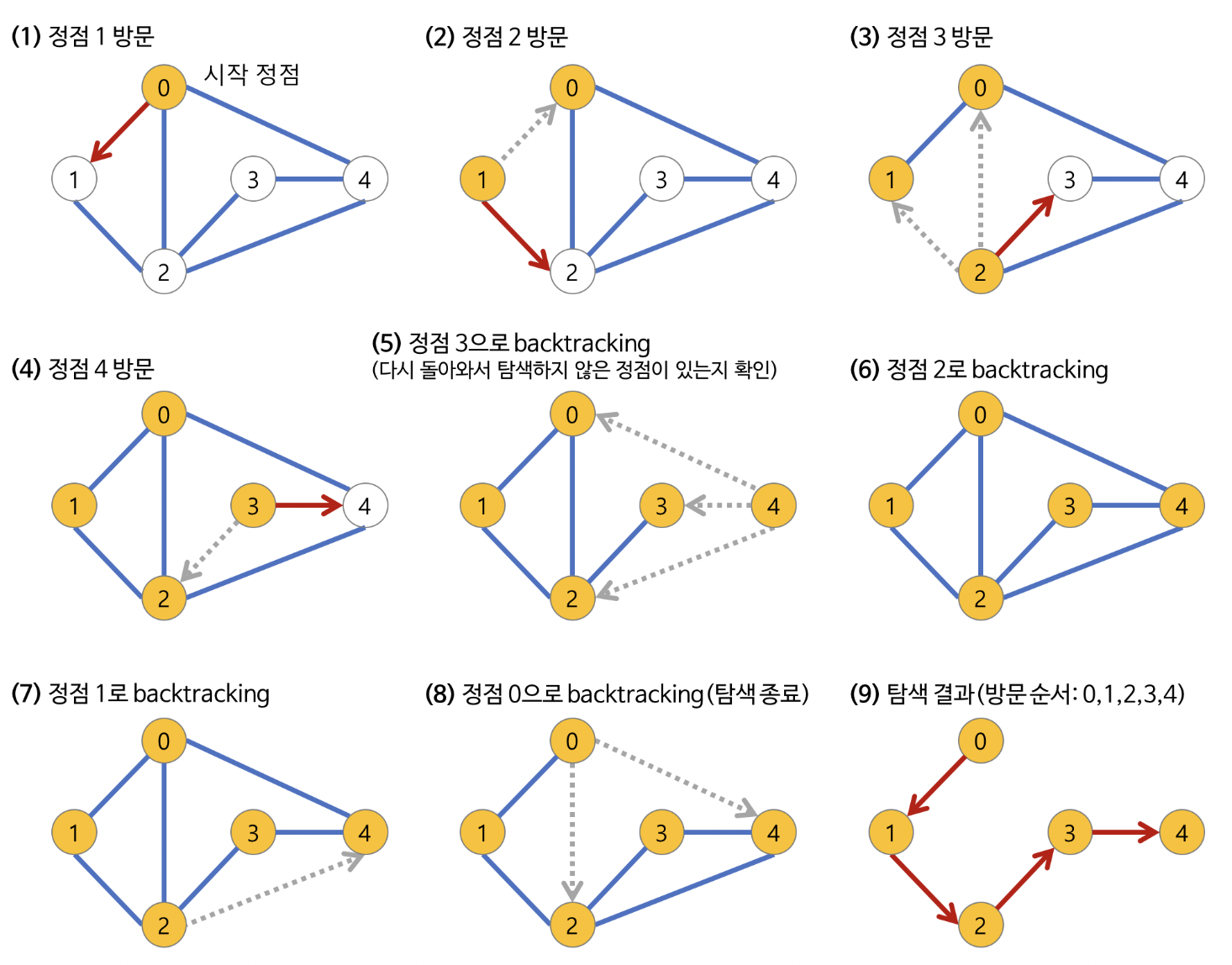
- Visit node 'a', the starting node, then mark the visited node as visited.
- Traverse the nodes adjacent to 'a' in order; if there are no adjacent nodes, terminate.
- If you visit node 'b', which is adjacent to 'a', you must visit all of 'b's neighbors before visiting another node adjacent to 'a'.
- Restart DFS with 'b' as the starting vertex to visit 'b's neighbors.
- Once all branches of 'b' have been completely explored, find an unvisited vertex among those adjacent to 'a'.
- This means you can only visit other neighbors of 'a' after all branches of 'b' have been completely explored.
- If there are no unvisited vertices, terminate.
- If there are, restart DFS with that vertex as the starting vertex.
Implementation Code #
oid search(Node root) {
  if (root == null) return;
  // 1. root 노드 방문
  visit(root);
  root.visited = true; // 1-1. 방문한 노드를 표시
  // 2. root 노드와 인접한 정점을 모두 방문
  for each (Node n in root.adjacent) {
    if (n.visited == false) { // 4. 방문하지 않은 정점을 찾는다.
      search(n); // 3. root 노드와 인접한 정점 정점을 시작 정점으로 DFS를 시작
    }
  }
}
순환 호출을 이용한 DFS 구현 (java 언어)
import java.io.*;
import java.util.*;

/* 인접 리스트를 이용한 방향성 있는 그래프 클래스 */
class Graph {
  private int V;   // 노드의 개수
  private LinkedList<Integer> adj[]; // 인접 리스트

  /** 생성자 */
  Graph(int v) {
      V = v;
      adj = new LinkedList[v];
      for (int i=0; i<v; ++i) // 인접 리스트 초기화
          adj[i] = new LinkedList();
  }

  /** 노드를 연결 v->w */
  void addEdge(int v, int w) { adj[v].add(w); }

  /** DFS에 의해 사용되는 함수 */
  void DFSUtil(int v, boolean visited[]) {
      // 현재 노드를 방문한 것으로 표시하고 값을 출력
      visited[v] = true;
      System.out.print(v + " ");

      // 방문한 노드와 인접한 모든 노드를 가져온다.
      Iterator<Integer> i = adj[v].listIterator();
      while (i.hasNext()) {
          int n = i.next();
          // 방문하지 않은 노드면 해당 노드를 시작 노드로 다시 DFSUtil 호출
          if (!visited[n])
              DFSUtil(n, visited); // 순환 호출
      }
  }

  /** 주어진 노드를 시작 노드로 DFS 탐색 */
  void DFS(int v) {
      // 노드의 방문 여부 판단 (초깃값: false)
      boolean visited[] = new boolean[V];

      // v를 시작 노드로 DFSUtil 순환 호출
      DFSUtil(v, visited);
  }

  /** DFS 탐색 */
  void DFS() {
      // 노드의 방문 여부 판단 (초깃값: false)
      boolean visited[] = new boolean[V];

      // 비연결형 그래프의 경우, 모든 정점을 하나씩 방문
      for (int i=0; i<V; ++i) {
          if (visited[i] == false)
              DFSUtil(i, visited);
      }
  }
}
/** 사용 방법 */
public static void main(String args[]) {
    Graph g = new Graph(4);

    g.addEdge(0, 1);
    g.addEdge(0, 2);
    g.addEdge(1, 2);
    g.addEdge(2, 0);
    g.addEdge(2, 3);
    g.addEdge(3, 3);

    g.DFS(2); /* 주어진 노드를 시작 노드로 DFS 탐색 */
    g.DFS(); /* 비연결형 그래프의 경우 */
}
Time Complexity of Depth-First Search (DFS)
DFS traverses all edges of a graph (number of vertices: N, number of edges: E).
- Graph represented by an adjacency list: O(N+E)
- Graph represented by an adjacency matrix: O(N^2)
Therefore, for a sparse graph with a small number of edges, using an adjacency list is more advantageous than an adjacency matrix.