Spring Security Filter
Filter #
A Filter is a component that performs certain operations before a request and after a response.
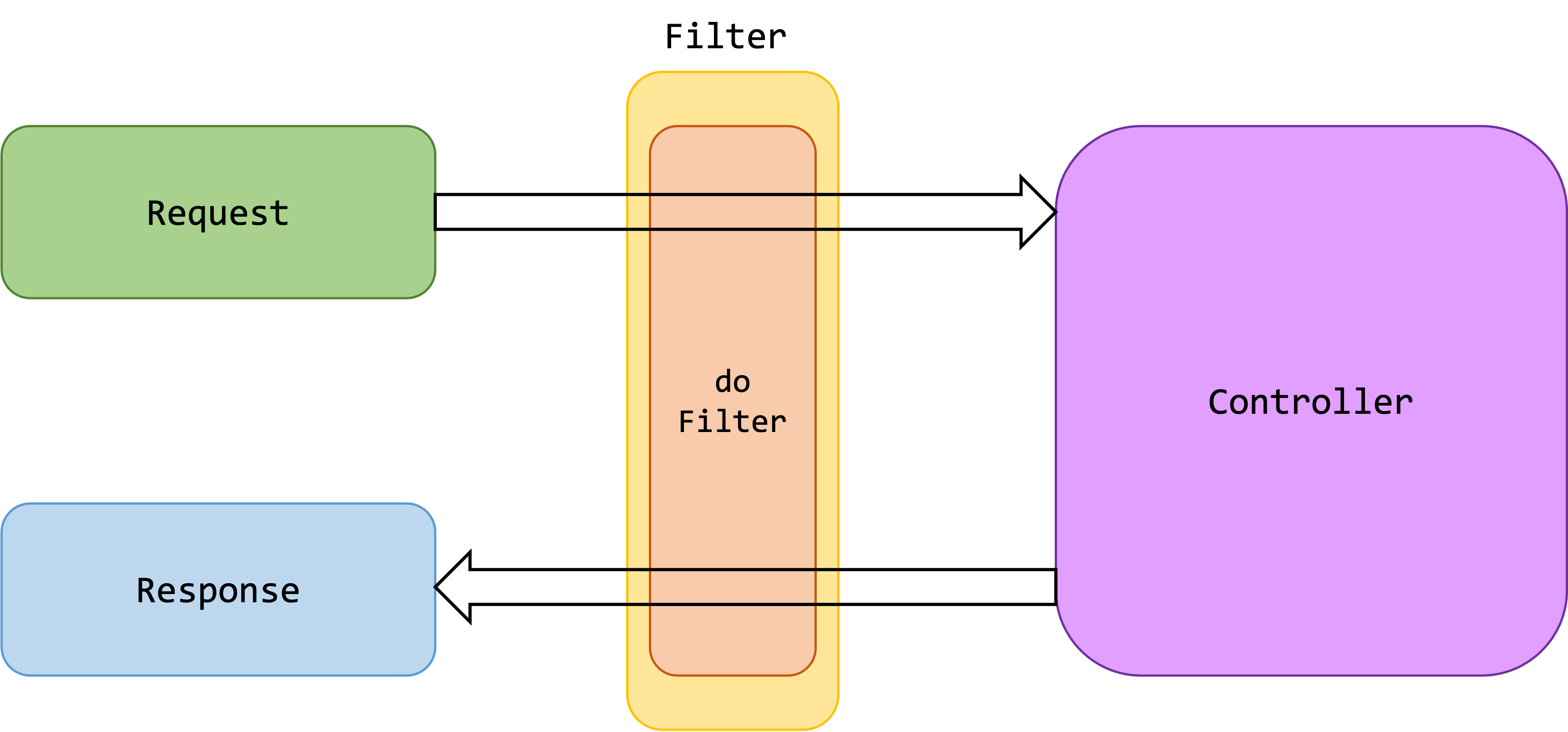
It's fair to say that Spring Security's operations are essentially driven by Filters.
- Various filters perform different functions.
- To understand what a filter does, you can examine the
doFiltermethod of theFilterclass.
- To understand what a filter does, you can examine the
- These filters can be excluded or added.
- You can define the order in which filters operate.
When there are multiple filters, they operate as follows:

Spring Security has several filters, and we will explore them one by one.
SecurityContextPersistenceFilter #
This is usually the second filter to be executed.
The first filter is
WebAsyncManagerIntegrationFilter, which helps process theSecurityContexteven for asynchronous requests.
This filter retrieves the SecurityContext and places it into the SecurityContextHolder.
If a SecurityContext is not found, it simply creates a new one.
BasicAuthenticationFilter #
Even without logging in, if you encode the ID and password in Base64 and include them in every request, BasicAuthenticationFilter will authenticate them.
No session is required, and authentication occurs with every request.
Stateless, meaning it does not store state.
Since the ID and password are repeatedly exposed with each request, it is vulnerable to security risks.
When using this filter, it is strongly recommended to use HTTPS.
Disable it as follows:
// SpringSecurityConfig.java

@Override
protected void configure(HttpSecurity http) throws Exception {
    http.httpBasic().dissable();
}
UsernamePasswordAuthenticationFilter #
This filter is responsible for username and password-based authentication using form data.
The UsernamePasswordAuthenticationFilter operates in the following sequence:
- ProviderManager(AuthenticationManager)
- Authentication information provider manager
- AbstractUserDetailsAuthenticationProvider
- Provides authentication information
- Checks account status, password matching, etc.
- DaoAuthenticationProvider
- Provides user information
- UserDetailsService
- User-provided service
CsrfFilter #
Defends against Csrf Attacks.
Csrf Attack #
Refers to maliciously forging a page to send malicious requests to a legitimate system.
To defend against this, a Csrf Token is used.
A legitimate page used by the system can make requests with the correct CSRF token, but a forged malicious page will not have the CSRF token used by the system, thus making requests with an incorrect CSRF token.
RememberMeAuthenticationFilter #
Allows login to be maintained for an extended period.
Even if the login session expires, it uses a remember-me cookie to re-establish the login session (login persistence style).
The default session expiration time is 30 minutes, but the default setting for RememberMeAuthenticationFilter is two weeks.
It is off by default and can be configured as follows:
// SpringSecurityConfig.java

@Override
protected void configure(HttpSecurity http) throws Exception {
    http.rememberMe();
}
AnonymousAuthenticationFilter #
When an unauthenticated user makes a request, it creates an Anonymous User and inserts an anonymous user token into the Authentication.
Even if not authenticated, it doesn't insert
nullbut rather creates a defaultAuthentication.
Other filters can then branch their processing based on whether the user is an Anonymous User or an authenticated User.
Enable it as follows:
// SpringSecurityConfig.java

@Override
protected void configure(HttpSecurity http) throws Exception {
    http.anonymous().principal("anonymousUser");
    // principal 없어도 됨. 이름 지정 st.
}
FilterSecurityInterceptor #
Although it ends with "Interceptor," it is a Filter.
Based on the authentication content passed to FilterSecurityInterceptor, it makes the final authorization decision.
Located towards the end of the filter chain.
- It retrieves the
Authenticationand, if there's an issue, throws anAuthenticationException. - If there's no issue with the
Authentication, it proceeds to determine authorization. - If authorization is denied, it throws an
AccessDeniedException.
ExceptionTranslationFilter #
Handles two types of Exceptions thrown by FilterSecurityInterceptor.
AuthenticationException: Authentication failureAccessDeniedException: Authorization failure
It determines what action to take when authentication or authorization fails.
Default Settings #
In the following cases, it redirects to the login page:
AuthenticationExceptionoccursAccessDeniedExceptionoccurs for an Anonymous user
In the following case, it redirects to a 403 Forbidden Whitelabel Error Page:
AccessDeniedExceptionoccurs for an authenticated User