Spring Package Structure - Layered vs. Domain-Driven
There are broadly two types of package organization:
- Layered
- Domain-Driven
Layered Package Structure #
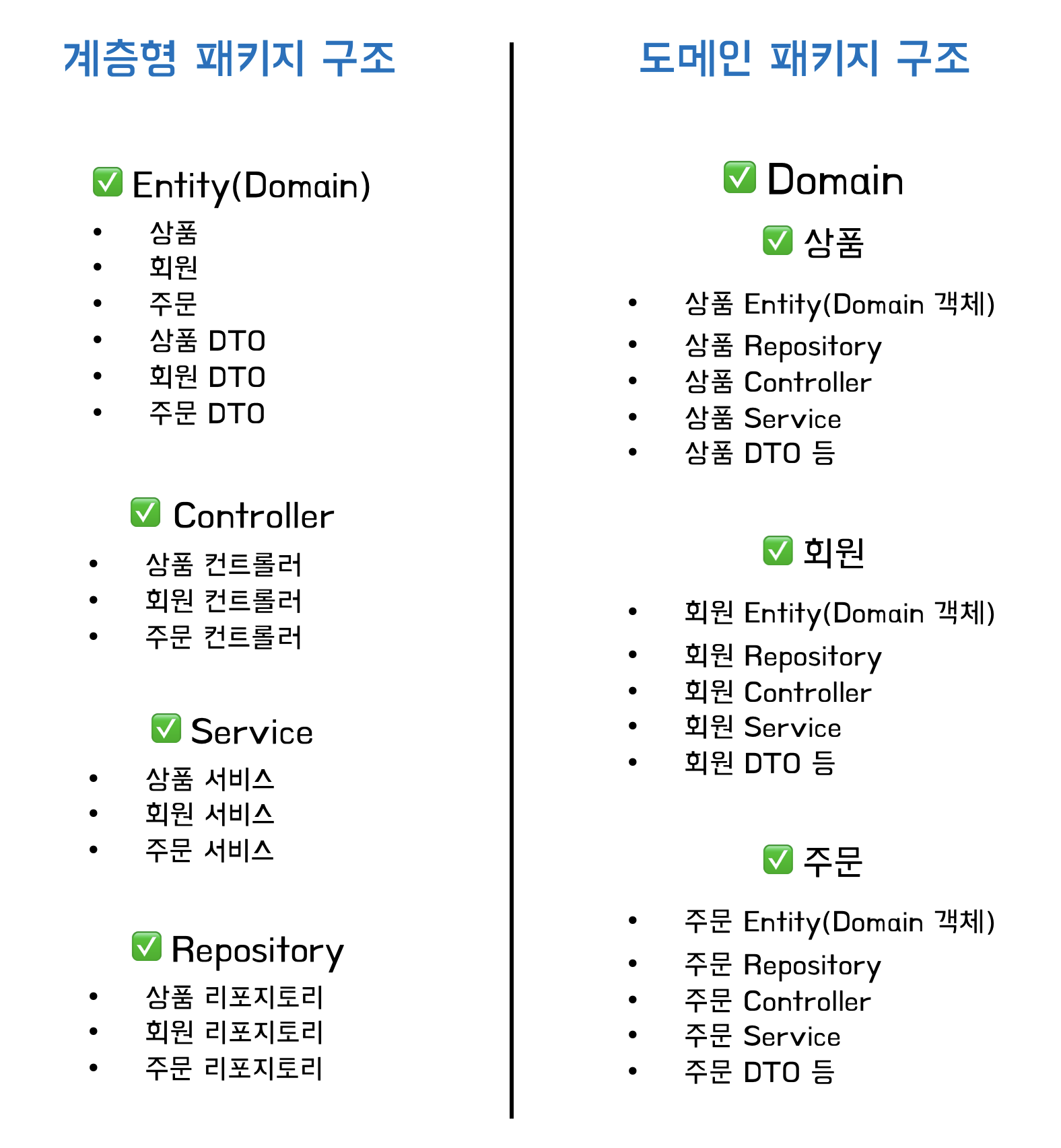
- A method of designing packages in a layered fashion.
- It has the advantage of quickly grasping the overall structure, but the disadvantage is that too many classes accumulate in a directory.
Advantages
- Even with relatively low understanding of the project, the overall structure can be quickly grasped.
Disadvantages
- Too many classes accumulate in a directory.
- Difficult to separate into modules.
Domain-Driven Package Structure #
- Organizes directories by domain.
- The domain structure has the advantage of cohesive related code, but it can be difficult to grasp the overall structure if one has a low understanding of the project.
Advantages
- Related code is cohesive.
- Advantageous when separating into modules.
Disadvantages
- Difficult to grasp the overall structure if one has a low understanding of the project.
- The criteria for distinguishing domains can vary depending on the developer's preference, and it can be hard to find related code if it's in a package different from what's expected.
- Potential for circular dependencies between packages.
- Even files that could reside within the same package might end up in different packages due to module-based separation, leading to mutual references.
Layered and Domain-Driven Examples #
Conclusion #
If complexity is high, many features are provided, leading to a large number of classes belonging to a single layer, features can be separated by clear criteria, and there's a possibility of splitting into separate services by module in the future, -> Domain-Driven Structure
If complexity is low, few features are provided, leading to a small number of classes belonging to a single layer, it's ambiguous to separate features by clear criteria, and it's a small-scale project unlikely to be split into modules in the future, -> Layered Structure
I would lean towards this direction.