How ObjectMapper Works and Additional Features Provided by Spring Boot
Serialization Using ObjectMapper #
How ObjectMapper's Serialization Works #
ObjectMapper uses reflection to create a JSON string from an object, which is called serialization.
This process occurs when using @RequestBody, @RestController, or ResponseEntity, among others.

In Spring, the ObjectMapper class from the Jackson module handles serialization by default. The writeValueAsString method of ObjectMapper is used in this process.
String jsonResult = objectMapper.writeValueAsString(myDTO());
To create a JSON string from an object, the field values must be known. Only then can a string like the following be created.
String message = "{\"name\":\"MangKyu\",\"age\":20}"
However, with ObjectMapper's default settings, only public fields or public getters are accessible.
While additional settings can be configured in ObjectMapper to increase visibility, getters are almost always present, so the default settings are usually sufficient.
Therefore, when using ObjectMapper, it's generally best practice to always create getters for serialization.
Caveats of Serialization Using ObjectMapper #
Due to how ObjectMapper handles serialization, it can sometimes produce unintended JSON messages.
For example, let's say you create a method in a DTO that starts with getX, like this:
@Getter
@NoArgsConstructor
@AllArgsConstructor
public class MangKyuRequest {

    private String name;
    private Integer age;

    public String getNameWithAge() {
        return name + "(" + age + ")";
    }

}
Serializing an object of the class above with ObjectMapper will produce the following JSON string:
{"name":"MangKyu","age":20,"nameWithAge":"MangKyu(20)"}
This is because getNameWithAge also follows the method naming convention for getters (starting with getX). If you're not aware of this, it can lead to incorrect JSON responses.
Therefore, understanding how ObjectMapper's deserialization works can be helpful.
Deserialization Using ObjectMapper #
How ObjectMapper's Deserialization Works #
ObjectMapper uses reflection to create an object from a JSON string, which is called deserialization.
In Spring, deserialization occurs when a JSON string is received as an object via @RequestBody.

Deserialization is typically processed through the following steps:
- Create an object using the default constructor.
- Find and bind field values.
First, an object is created; if a default constructor is not present, an error is thrown.
After creating an object with the default constructor, field values must be found, which can typically be done via public fields or public getters/setters.
If the process fails, an exception will occur, so it's best to always create a default constructor and getter methods.
com.fasterxml.jackson.databind.exc.InvalidDefinitionException: Cannot construct instance of `com.mang.atdd.membership.objectmapper.MyDTO` (no Creators, like default constructor, exist): cannot deserialize from Object value (no delegate- or property-based Creator)
 at [Source: (String)"{"name":"MangKyu","age":20}"; line: 1, column: 2]

	at com.fasterxml.jackson.databind.exc.InvalidDefinitionException.from(InvalidDefinitionException.java:67)
	at com.fasterxml.jackson.databind.DeserializationContext.reportBadDefinition(DeserializationContext.java:1904)
	at com.fasterxml.jackson.databind.DatabindContext.reportBadDefinition(DatabindContext.java:400)
	at com.fasterxml.jackson.databind.DeserializationContext.handleMissingInstantiator(DeserializationContext.java:1349)
	at com.fasterxml.jackson.databind.deser.BeanDeserializerBase.deserializeFromObjectUsingNonDefault(BeanDeserializerBase.java:1415)
	at com.fasterxml.jackson.databind.deser.BeanDeserializer.deserializeFromObject(BeanDeserializer.java:352)
	at com.fasterxml.jackson.databind.deser.BeanDeserializer.deserialize(BeanDeserializer.java:185)
	at com.fasterxml.jackson.databind.deser.DefaultDeserializationContext.readRootValue(DefaultDeserializationContext.java:323)
	at com.fasterxml.jackson.databind.ObjectMapper._readMapAndClose(ObjectMapper.java:4674)
	at com.fasterxml.jackson.databind.ObjectMapper.readValue(ObjectMapper.java:3629)
	at com.fasterxml.jackson.databind.ObjectMapper.readValue(ObjectMapper.java:3597)
Handling Deserialization Indirectly #
If you need to create an object using an indirect method rather than a default constructor, two separate steps are required:
- Add the
ParameterNamesmodule toObjectMapper - Add the
-parametersoption to Java compilation
The Jackson module for ObjectMapper includes the parameter-names module, as follows:
 // <https://mvnrepository.com/artifact/com.fasterxml.jackson.module/jackson-module-parameter-names>
implementation group: 'com.fasterxml.jackson.module', name: 'jackson-module-parameter-names'
Registering this module with ObjectMapper allows ObjectMapper to use indirect methods.
For example, information based on parameter details, such as constructors with parameters, becomes usable.
ObjectMapper objectMapper = new ObjectMapper();
objectMapper.registerModule(new ParameterNamesModule());
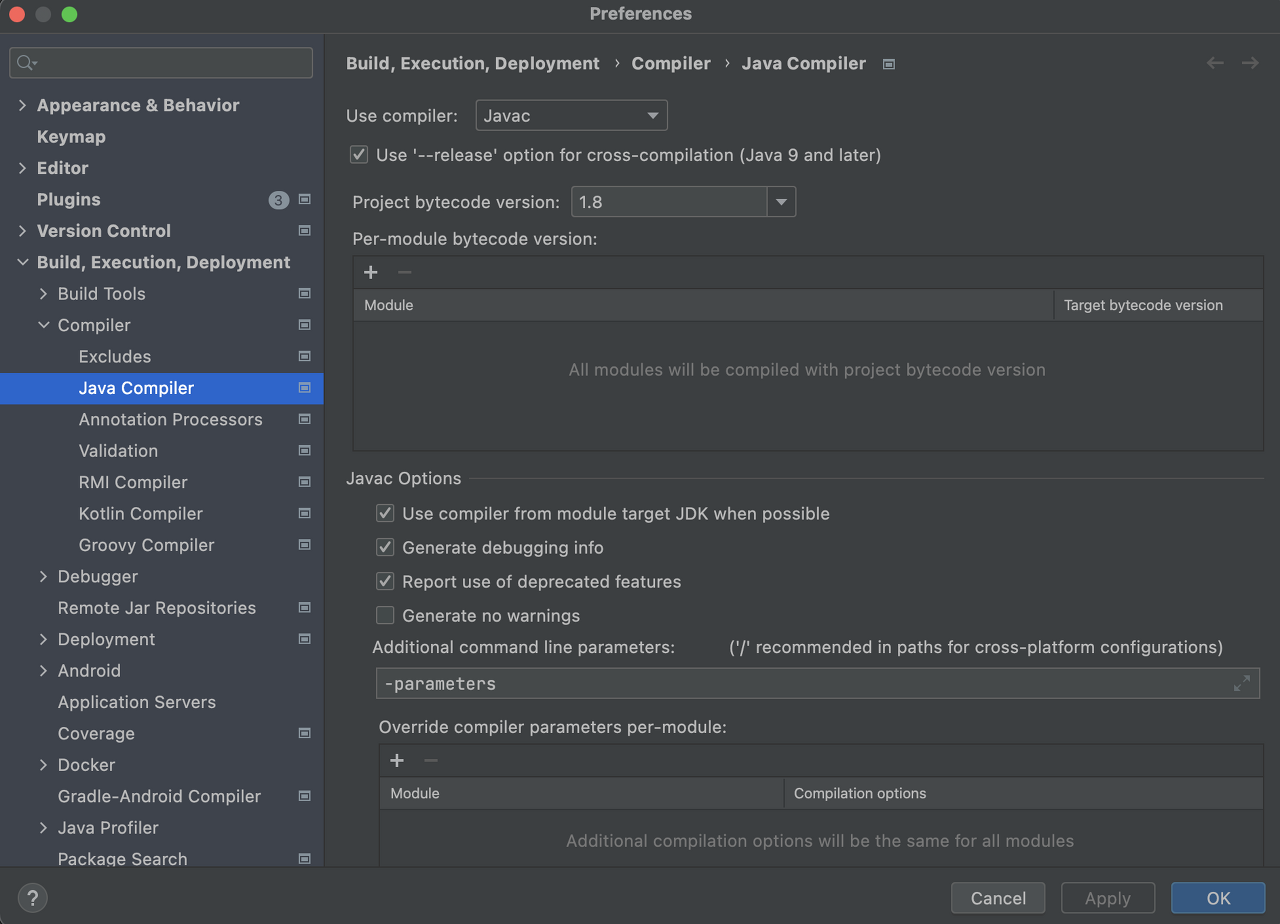
To leverage ParameterNamesModule, you need to be able to retrieve parameter information, which can be done by using Java compilation's -parameters option.
Adding the -parameters option to Java compilation (for JDK 8 and above) adds information to the compiled class, allowing parameter information to be retrieved via the reflection API at compile time.
For reference, IntelliJ's -parameters option can be added as shown below, and it requires a Build > Rebuild Projects to take effect.
Additional Features Provided by Spring Boot #
However, when developing with Spring Boot on a Gradle-based project, you might experience objects being created successfully without errors, even when a default constructor is absent.
This is because Spring Boot provides additional configurations and plugins.
First, the -parameters option is handled by Spring Boot's Gradle Java plugin.
Using this plugin automatically adds the -parameters option to Java compilation.
plugins {
    id 'org.springframework.boot' version '2.7.5'
    id 'io.spring.dependency-management' version '1.0.11.RELEASE'
    id 'java'
}
The addition of the ParameterNames module is handled during Jackson's AutoConfiguration.
Similar to other modules, if this module's dependency is present, the configuration is automatically added.
@Configuration(proxyBeanMethods = false)
@ConditionalOnClass(ParameterNamesModule.class)
static class ParameterNamesModuleConfiguration {

    @Bean
    @ConditionalOnMissingBean
    ParameterNamesModule parameterNamesModule() {
        return new ParameterNamesModule(JsonCreator.Mode.DEFAULT);
    }
Conclusion: DTO Classes Should Be As Follows #
It is inefficient to develop while constantly keeping the details explained above in mind.
Furthermore, this only adds unnecessary cognitive load.
So, I've established a rule for myself: mindlessly attach the following code to DTOs.
This allows us to provide a consistent approach to DTOs without burden.
If @ModelAttribute usage is required, simply add @Setter without overthinking it.
@Getter
@Builder
@NoArgsConstructor
@AllArgsConstructor
public class MangKyuRequest {

    private String name;
    private Integer age;

}