Flexible Parameter Handling with Spring ArgumentResolver
When operating a service, you often receive various types of data.
Each time, this data needs to be pre-processed in the Controller. In such cases, the only way to reduce code is to either encapsulate the pre-processing logic in a function or create a utility class and inject it as a dependency.
However, even with utility classes, there's the inconvenience of having to call a function every time. This leads to duplicated code, and as it grows, the code becomes messy.
Spring provides an interface to handle such parameters in a common way, and that is the Argument Resolver.
Spring ArgumentResolver #
When logic is needed to process data received from an API endpoint, such as extracting only necessary information, SpringArgumentResolver is used. This can be applied by extending HandlerMethodArgumentResolver to create a new Resolver tailored to the application, and then adding it to the Resolver list when the application runs.
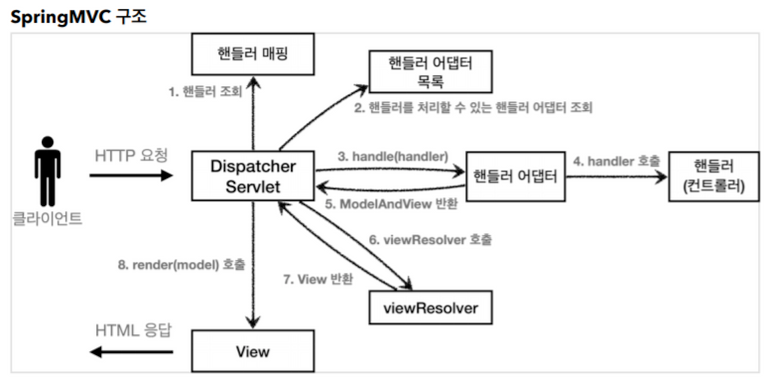
Spring MVC processes requests in the following flow:
- When a user makes a request via a web browser, the DispatcherServlet receives it.
- The DispatcherServlet searches for the URI matching the request in the HandlerMapping.
- At this point, it finds APIs implemented with RequestMapping, all of which are held by
RequestMappingHandlerAdapter. - If the desired mapping is found, the Interceptor is processed first.
- Argument Resolver processing
- Message Converter processing
- At this point, it finds APIs implemented with RequestMapping, all of which are held by
- Controller Method Invoke
Example #
Let's see how it can be used in a real Spring Framework application.
As an example, we'll create an API that displays the client's browser information on the screen, regardless of the string value provided.
@Target(ElementType.PARAMETER)
@Retention(RetentionPolicy.RUNTIME)
public @interface UserInfo {
}
First, we create an annotation to distinguish parameters. This annotation is used at API endpoints to indicate a specific type of data.
@RestController
public cass BrowserUserController {

    @GetMapping("/")
    public String getBrowser(@UserInfo String clientInfo){
        return clinetInfo;
    }
}
The API is designed to return the string information provided by the client as-is.
@Component
public class BrowserUserArgumentResolver implements HandlerMethodArgumentResolver {

    // Callback function that checks the parameter value of the called controller

    @Override
    public boolean supportsParameter(MethodParameter parameter) {
        return parameter.getParameterAnnotation(UserInfo.class) != null
            && parameter.getParamterType().equals(String.class);
    }

    // Function called when the supportsParameter callback function returns true
    @Override
    public Object resolveArgument(MethodParameter parameter, ModelAndViewContainer mavContainer, NativeWebRequest webRequest, WebDataBinderFactory binderFactory) throws Exception {
        HttpServletRequest request = (HttpServletRequest)webRequest.getNativeRequest();
        return request.getHeader("User-Agent");
    }

}
Now, we create a Resolver for a specific argument type. Since we created an annotation for this purpose, we can implement the supportParameter callback function to return true if it's our custom annotation, after inheriting HandlerMethodArgumentResolver.
Finally, we implement how the parameter is returned in the resolveArgument function, and that's it.
Since we only need to provide browser information regardless of the data value received, we return the header value using getHeader from the Request parameter.
@RequiredArgsConstructor
@SpringBootApplication
public class ArgumentexampleApplication extends WebMvcConfigurationSupport {

    private final BrowserUserArgumentResolver loginUserArgumentResolver;

    @Override
    protected void addArgumentResolvers(List<HandlerMethodArgumentResolver> argumentResolvers) {
        super.addArgumentResolvers(argumentResolvers);
        argumentResolvers.add(loginUserArgumentResolver);
    }

    public static void main(String[] args) {
        SpringApplication.run(ArgumentexampleApplication.class, args);
    }
}
Now, we need to add the Resolver defined for the application. To do this, we extend the WebMvcConfigurationSupport class in the application's main class and override the addArgumentResolvers function to add the Resolver we created to the list of argumentResolvers in that parameter.