Netty Message Flow
Netty requests message transmission through a Channel.
Channel channel = ...
channel.writeAndFlush(message);
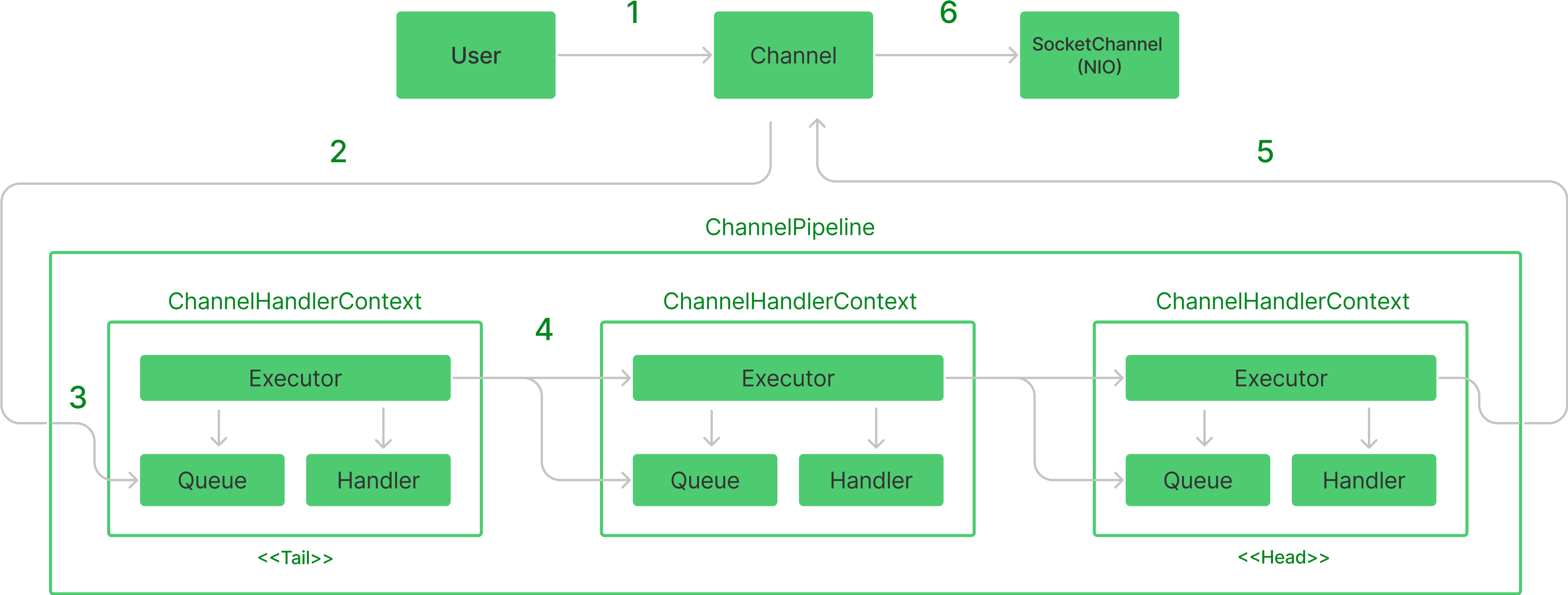
The Channel delivers messages to the ChannelPipeline. The ChannelPipeline fundamentally contains TailContext and HeadContext. (These can be considered the beginning and end of the Pipeline.)
Between the Tail and Head, user-registered ChannelHandlerContexts are connected in a chain structure, and the delivered message flows along this chain in the Outbound direction.
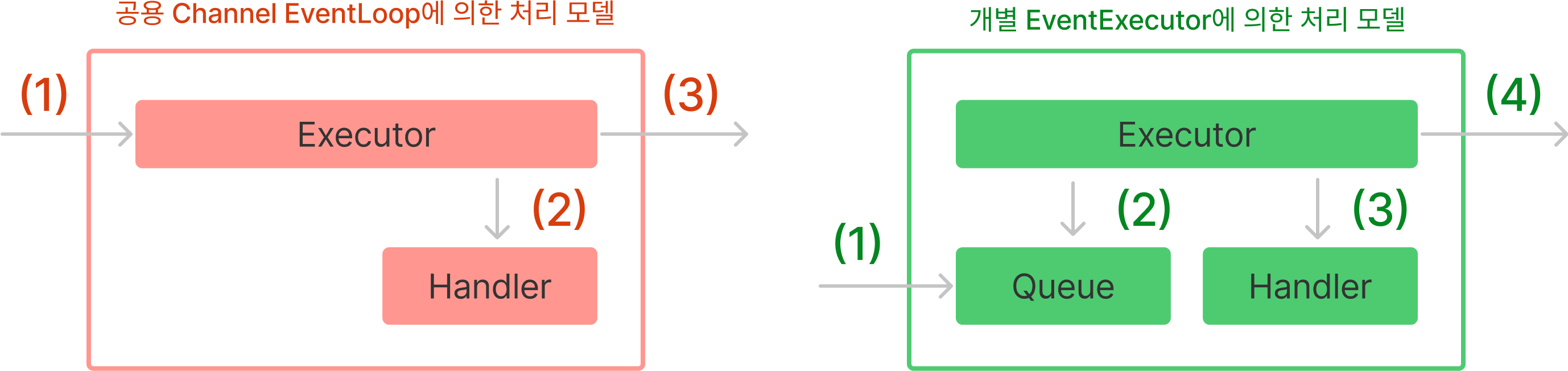
Each time a message passes through a handler in the ChannelPipeline, it checks whether the EventExecutor thread bound to the handler matches the thread currently requesting message transmission.
If the threads are different, the message is inserted into a Queue, and execution is returned immediately. Messages accumulated in the Queue are then processed asynchronously by the EventExecutor. In the first ChannelHandlerContext of the Pipeline, the requesting thread and the EventExecutor are always different, and the message is queued.
abstract class AbstractChannelHandlerContext ... {
    private void write(Object msg, boolean flush, ChannelPromise promise) {
    	...
        EventExecutor executor = next.executor();
        if (executor.inEventLoop()) {
            if (flush) {
                next.invokeWriteAndFlush(m, promise);
            } else {
                next.invokeWrite(m, promise);
            }
        } else {
            final WriteTask task = WriteTask.newInstance(next, m, promise, flush);
            if (!safeExecute(executor, task, promise, m, !flush)) {
                task.cancel();
            }
        }
        ...
    }
}
If the user has not configured a separate EventExecutor (default), all handlers will share and use the Channel's EventLoop thread. Therefore, message buffering in the Queue will not occur except at the Pipeline's Tail.
Conversely, if the user has configured an EventExecutor for a specific Handler, messages will be buffered in the Queue at handlers where the Executor differs, and then processed asynchronously by different EventExecutors.
abstract class AbstractChannelHandlerContext ... {
    public EventExecutor executor() {
        if (executor == null) {
            return channel().eventLoop();
        } else {
            return executor;
        }
    }
}
Messages that have passed through the Pipeline are then delivered back to the Channel.
Netty's Channel internally transmits messages over the network via an NIO channel.
public class NioSocketChannel ... {
    protected void doWrite(ChannelOutboundBuffer in) throws Exception {
        SocketChannel ch = javaChannel();
        ...
        ByteBuffer buffer = nioBuffers[0];
        int attemptedBytes = buffer.remaining();
        final int localWrittenBytes = ch.write(buffer);
        if (localWrittenBytes <= 0) {
            incompleteWrite(true);
            return;
        }
        ...
    }
}