EventLoopGroup
Before diving in, let's take a deep dive into the Bootstrap configuration and binding required to set up and run a Server Netty application.
public static void main(String[] args) throws InterruptedException {
    EventLoopGroup bossGroup = new NioEventLoopGroup(1);
    EventLoopGroup workerGroup = new NioEventLoopGroup();

    try {
        ServerBootstrap b = new ServerBootstrap();
        b.group(bossGroup, workerGroup)
                .channel(NioServerSocketChannel.class)
                .childHandler(new NettyServerInitializer());

        // 서버 시작
        log.info("start server...");
        ChannelFuture f = b.bind(8080).sync();
        f.addListener((ChannelFuture future) -> {
            if (future.isSuccess()) {
                log.info("Server bound");
            } else {
                log.error("Bind attempt failed", future.cause());
            }
        });

        f.channel().closeFuture().sync();
    } finally {
        log.info("close server...");
        workerGroup.shutdownGracefully();
        bossGroup.shutdownGracefully();
    }
}
Looking at the Bootstrap configuration, the first thing done is creating EventLoops as shown below.
EventLoopGroup bossGroup = new NioEventLoopGroup(1);
EventLoopGroup workerGroup = new NioEventLoopGroup();
Since we will be looking at it based on Nio, the code above instantiates
NioEventLoopGroup. AnEventLoopGroupcombines multipleEventLoops.
The bossGroup is a group of EventLoops that establish new connections, and the workerGroup is a group responsible for reading and writing data within established connections.
NioEventLoopGroup #
First, let's look at NioEventLoopGroup creation.
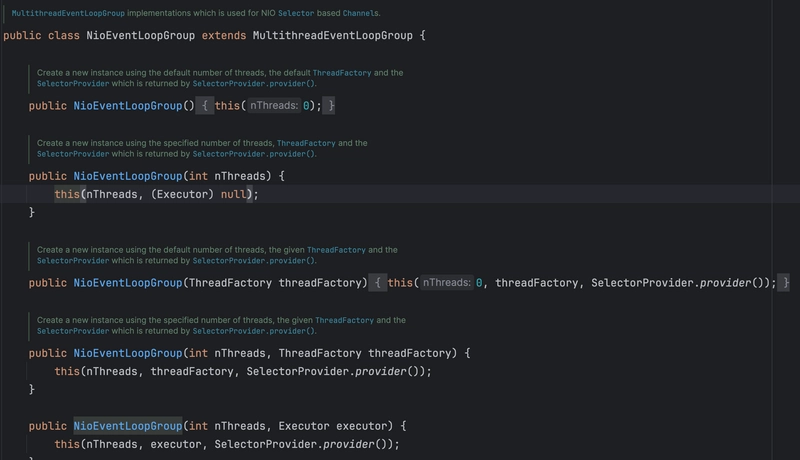
It has various constructors, and the properties initialized and assigned through many of them are as follows:
- nThreads: The number of threads to use, or more precisely, the number of
EventLoops.- Thread 1:1 EventLoop
- The default value is twice the number of available cores.
- executor:
Executorconfiguration to allocate threads forEventLoops within theEventLoopGroup.- Acts as a thread pool (Thread Provider) that allocates threads for
EventLoops.
- Acts as a thread pool (Thread Provider) that allocates threads for
- selectorProvider: Selector Provider (Nio, epoll, etc.)
- selectorStrategyFactory: Factory that creates a selector strategy.
- SelectStrategy: A policy that controls the loop operating to perform a select. For example, it can set policies such as delaying or skipping the select if there are events that need immediate processing.
- rejectedExecutionHandler: Handler for tasks that cannot be executed by the
Executor.
NioEventLoopGroup uses the properties above as arguments during creation to instantiate EventLoops.
And many of NioEventLoop's constructors ultimately call super(), invoking the constructor of its superclass, MultithreadEventLoopGroup.
MultithreadEventLoopGroup #
When NioEventLoopGroup is instantiated, it calls the constructor of its superclass, MultithreadEventLoopGroup.
Looking at the code below, you can see the default number of threads mentioned earlier.
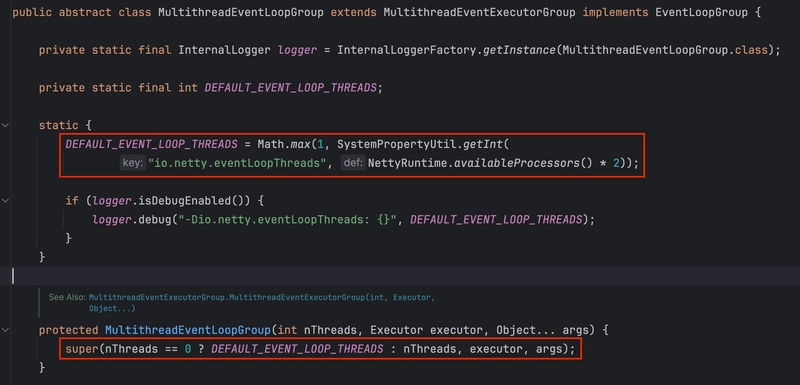
The code shows that it's set to 2 * the number of available processors, and it then calls the constructor of its superclass,
MultithreadEventExecutorGroup.
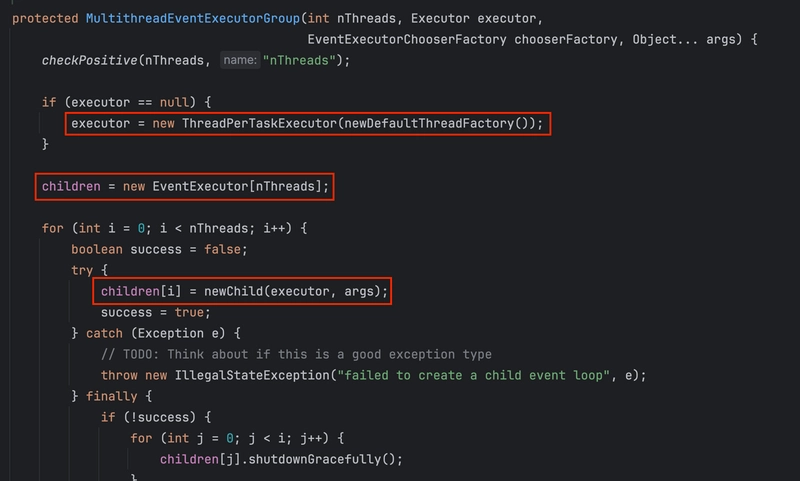
Looking at the MultithreadEventExecutorGroup constructor, if the executor is not explicitly configured, it uses DefaultThreadFactory. Its internal logic reveals that it creates and allocates a new thread every time.
Then, through the newChild() method, it creates EventLoop instances according to the provided number of threads and stores them in an array.
newChild() is an abstract method that provides implementations based on the selector type, as shown below.

For Nio, you should look at the newChild() implementation of NioEventLoopGroup.
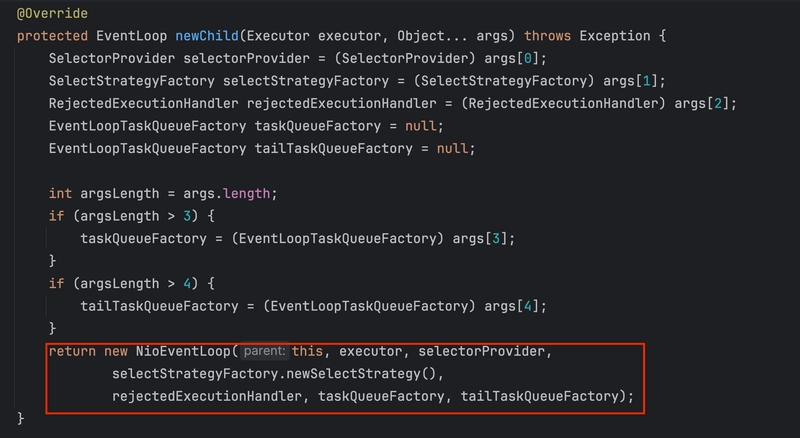
It creates EventLoop instances using the executor, selectorProvider, selectorStrategyFactory, etc., passed as constructor arguments within the EventLoopGroup.
NioEventLoop Creation and Initialization #
The various properties received by NioEventLoopGroup's constructor are ultimately for creating an EventLoop. And looking at NioEventLoop's constructor, it is as follows.
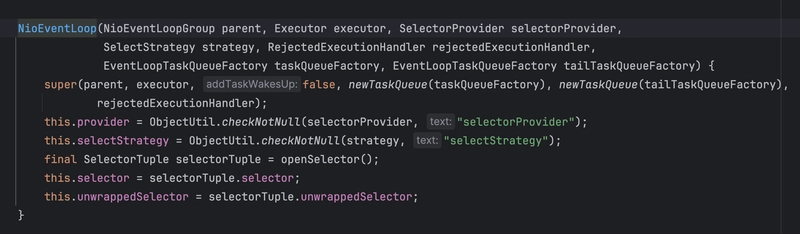
Looking at the constructor, it initializes the EventLoop using various properties passed during NioEventLoopGroup instantiation, and the selector is allocated by calling openSelector().
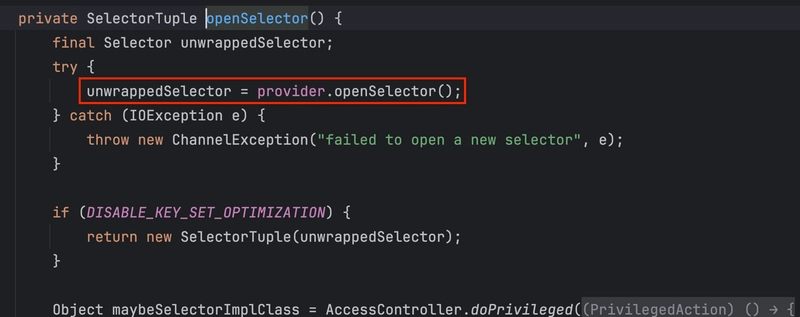
Calling openSelector() returns a new selector according to the provider implementation, as shown above (Nio, epoll, etc.).
In traditional Nio, channels requiring I/O processing were directly registered with the selector, but in Netty, since the event loop has the selector, you just need to register the channel with the event loop.
SingleThreadEventLoop #
Looking at the NioEventLoop constructor above, it calls the constructor of its superclass, SingleThreadEventLoop.

As can be seen in the code, creation is delegated to the superclass, SingleThreadEventExecutor.
Within the SingleThreadEventExecutor constructor, a Thread is allocated from the Executor and a TaskQueue is instantiated, as shown below.
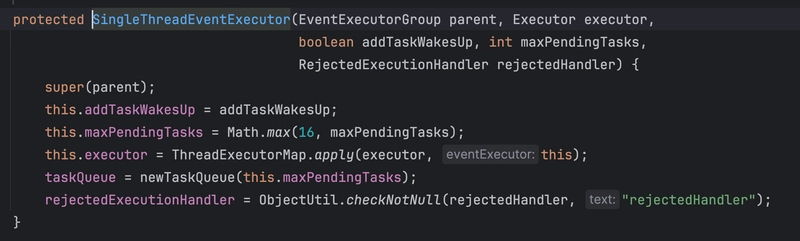
As can be seen above, an event loop consists of 1 thread + 1 selector + 1 task queue.
We've examined the process of creating nioEventLoopGroup and assigning various properties in the code below:
EventLoopGroup bossGroup = new NioEventLoopGroup(1);
EventLoopGroup workerGroup = new NioEventLoopGroup();
The important point is that each nioEventLoop has its own Selector, thread, and taskQueue, and by including identical EventLoops in an EventLoopGroup, resources are distributed.
Now, using Bootstrap, the EventLoopGroup above is configured by dividing roles into boss and child.
EventLoopGroup bossGroup = new NioEventLoopGroup(1);
EventLoopGroup workerGroup = new NioEventLoopGroup();

ServerBootstrap b = new ServerBootstrap();
b.group(bossGroup, workerGroup)
        .channel(NioServerSocketChannel.class)
        .childHandler(...);
And at this point, the channel, event loops, and handlers to be used are set as handler and channelHandler, respectively.