Optimize Higher-Order Functions Using inline fun
Problems When Receiving Lambda Expressions as Function Parameters #
Typically, when a function is called, it executes as a subroutine.
On the other hand, when a function declared with inline fun is called, instead of executing a function call, the code inside that function is inserted and executed at the call site.
fun main(args: Array<String>) {
  printWorldAfterFunction {
    println("Hello")
  }
}

fun printWorldAfterFunction(function: () -> Unit) {
  function()
  println("World")
}
In the code above, when the printlnWorldAfterFunction function is executed with a () -> Unit type lambda expression, the () -> Unit type lambda expression is created as an anonymous class and instantiated. If this code is converted to bytecode and then decompiled into Java code, it results in the following:
public final class InlineFunKt {
   public static final void main(@NotNull String[] args) {
      Intrinsics.checkNotNullParameter(args, "args");
      printWorldAfterFunction((Function0)null.INSTANCE);
   }

   public static final void printWorldAfterFunction(@NotNull Function0 function) {
      Intrinsics.checkNotNullParameter(function, "function");
      function.invoke();
      String var1 = "World";
      System.out.println(var1);
   }
}
We can see that the function parameter we provided is created as an anonymous class implementing Function0, and an instance of this class is passed to printWorldAfterFunction.
Although it's shown as
null.INSTANCEhere,Function0is actually an object that executesprintln("Hello")wheninvokeis called.
In other words, using a lambda as a function argument creates a new class instance.
Creating a new instance of an anonymous class in memory every time the function is called is detrimental to performance.
Performance Optimization Using inline fun #
To solve the problem mentioned above, inline fun was introduced. Let's declare printWorldAfterFunction as an inline fun.
fun main(args: Array<String>) {
  printWorldAfterFunction {
    println("Hello")
  }
}

inline fun printWorldAfterFunction(function: () -> Unit) {
  function()
  println("World")
}
If we convert it to bytecode again and decompile it into Java, we get the following result:
public final class InlineFunKt {
   public static final void main(@NotNull String[] args) {
      Intrinsics.checkNotNullParameter(args, "args");
      int $i$f$printWorldAfterFunction = false;
      int var2 = false;
      String var3 = "Hello";
      System.out.println(var3); // 그대로 코드로 대입
      String var4 = "World";
      System.out.println(var4); // 그대로 코드로 대입
   }

   public static final void printWorldAfterFunction(@NotNull Function0 function) {
      int $i$f$printWorldAfterFunction = 0;
      Intrinsics.checkNotNullParameter(function, "function");
      function.invoke();
      String var2 = "World";
      System.out.println(var2);
   }
}
In this code, we can see that the main function no longer calls printWorldAfterFunction. Furthermore, an anonymous class implementing Function0 and its instance are no longer created. Instead, the code of printWorldAfterFunction and the lambda expression we passed as the function parameter are directly inserted into the code.
This way, although the code becomes slightly longer, it enables performance optimization by avoiding the creation of new anonymous object instances.
For reference, declaring a function that does not receive a lambda expression as an argument with inline fun does not yield any significant performance difference.
inline fun printString(string: String) {
	println(string)
}
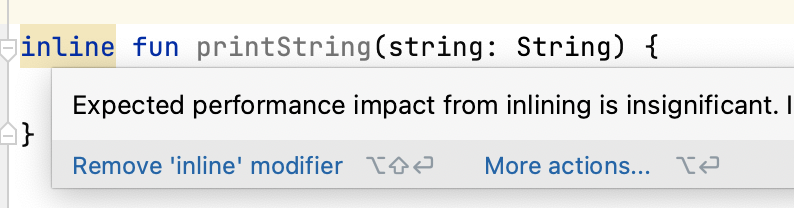
The reason is... I believe you'll understand if you've read this article carefully.