suspend fun
A suspend function, declared with suspend fun, is a special function that can contain suspension points within its body.
Recall that coroutines can suspend at any time and yield the thread. Suspend functions serve to create reusable blocks of code that include suspension points, which are executed within a coroutine.
fun main() = runBlocking<Unit> {
    delay(100L)
    println("Hello Coroutines")
    delay(100L)
    println("Hello Coroutines")
}
In this code, the delay function and println function are repeated. Therefore, this code can be refactored into a function as follows:
fun delayAndPrintHelloCoroutines() {
    delay(100L)
    println("Hello Coroutines")
}
However, if you check in the IDE, you'll see an error.
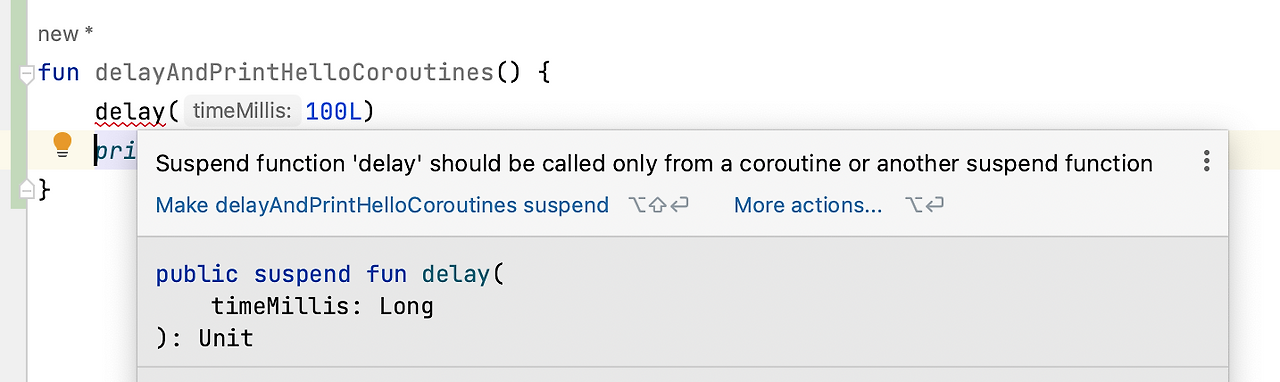
This means that delay, which is a suspend function, can only be called from another suspend function (suspend fun). Why does this error occur? It's because the delay function is declared as a suspend function since it makes the coroutine yield the thread for a certain period. Therefore, the caller of this function must also be a suspend function.
Simply changing fun to suspend fun resolves the issue.
suspend fun delayAndPrintHelloCoroutines() {
    delay(100L)
    println("Hello Coroutines")
}
Suspend functions are not coroutines. #
So, how long would it take to execute the following main function?
fun main() = runBlocking<Unit> {
    delayAndPrintHelloCoroutines()
    delayAndPrintHelloCoroutines()
}

suspend fun delayAndPrintHelloCoroutines() {
    delay(100L)
    println("Hello Coroutines")
}
The answer is 200 milliseconds. This is because calling a suspend function does not create a new coroutine; it executes within the same coroutine, waiting 100 milliseconds and then printing. To confirm this, if you run the following code, you'll see it takes slightly more than 200 milliseconds.
fun main() = runBlocking<Unit> {
    val startTime = System.currentTimeMillis()
    delayAndPrintHelloCoroutines()
    delayAndPrintHelloCoroutines()
    println("${System.currentTimeMillis() - startTime}") // Prints 211
}
If you want a suspend function to run in a new coroutine, you must wrap it with a coroutine builder like launch or async.
fun main() = runBlocking<Unit> {
    val startTime = System.currentTimeMillis()
    val job1 = launch {
        delayAndPrintHelloCoroutines()
    }
    val job2 = launch {
        delayAndPrintHelloCoroutines()
    }
    job1.join()
    job2.join()
    println("${System.currentTimeMillis() - startTime}") // Prints 110
}
Then, each suspend function will execute in parallel, and you can see that the execution time is 110 milliseconds.
Calling suspend functions from within suspend functions #
fun main() = runBlocking<Unit> {
    val startTime = System.currentTimeMillis()
    delayAndPrintHelloCoroutines()
    delayAndPrintHelloCoroutines()
}
In this code, if the delayAndPrintHelloCoroutines method were declared with fun, it would result in an error. The reason is that delay is a suspend function. As seen here, a suspend function can only be called from another suspend function. This means that any function called from within a suspend fun must also be a suspend fun.
Suspend functions in coroutines #
So, where is the topmost suspend function called from? It's from a coroutine. A regular function, once executed, runs to completion and does not have the concept of suspension. Since suspension is a special feature exclusive to coroutines, suspend functions must be called from within a coroutine. In the code above, the suspend function is called from within the runBlocking coroutine.