Coroutine State Variables
Job's State Variables: isActive, isCancelled, isCompleted #
A Job has three state variables, which can be accessed as shown in the figure below.
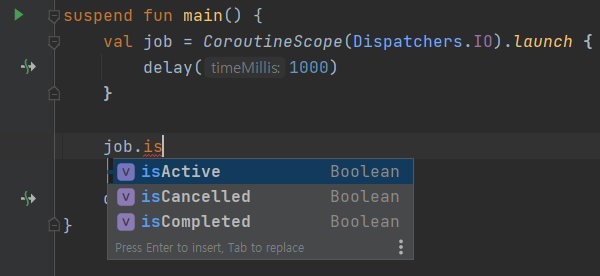
isActive: Indicates whether the Job is running.isCancelled: Indicates whether a Job cancel request has been made.isCompleted: Indicates whether the Job's execution is complete or cancellation is complete.
Changes when a Job is created with the CoroutineStart.LAZY option #
Let's explore the Job's state variables using the CoroutineStart.LAZY option to prevent the Job from automatically transitioning from created to running state.
When a Job is created with CoroutineStart.LAZY, it remains in the New state. At this point, it is neither running nor canceling, and isActive, isCancelled, and isCompleted are all false.
Now, when the Job transitions to the running state via start() or join(), isActive changes to true.
State Changes when a Job is Cancelled #
Let's find out what happens to the Job's state when cancel is called.
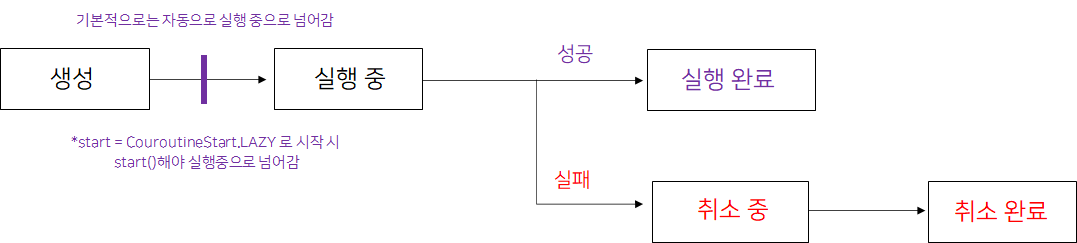
First, the Job transitions to the Cancelling state. isCancelled is a variable indicating whether cancellation has been requested, so it always becomes true when cancel is called. However, since cancellation is not yet complete while in the cancelling state, isCompleted is false.
If cancellation is completed, isCompleted() changes to true. invokeOnCompletion is a method that observes the state of isCompleted and is called when isCompleted changes from false to true. Therefore, it is also called when cancellation is complete.
State Changes when a Job is Completed #
When a Job is completed, isActive changes from true to false, and isCompleted changes from false to true.
Since isCompleted changed from false to true, the lambda expression set via invokeOnCompletion is called, just as with cancellation.