CoroutineDispatcher
In CoroutineDispatcher, 'Coroutine' refers to a coroutine, and 'Dispatch' means 'to send' in Korean. Therefore, CoroutineDispatcher refers to an object that sends coroutines. So, where does it send coroutines? It sends them to threads.
All tasks must run on a thread, and since coroutines are also tasks, they can only run on a thread. Therefore, an object is needed to send the created coroutines to threads, and CoroutineDispatcher fulfills this role.
When we create a coroutine and request its execution from a CoroutineDispatcher, the CoroutineDispatcher sends the coroutine to one of the threads in its available thread pool.
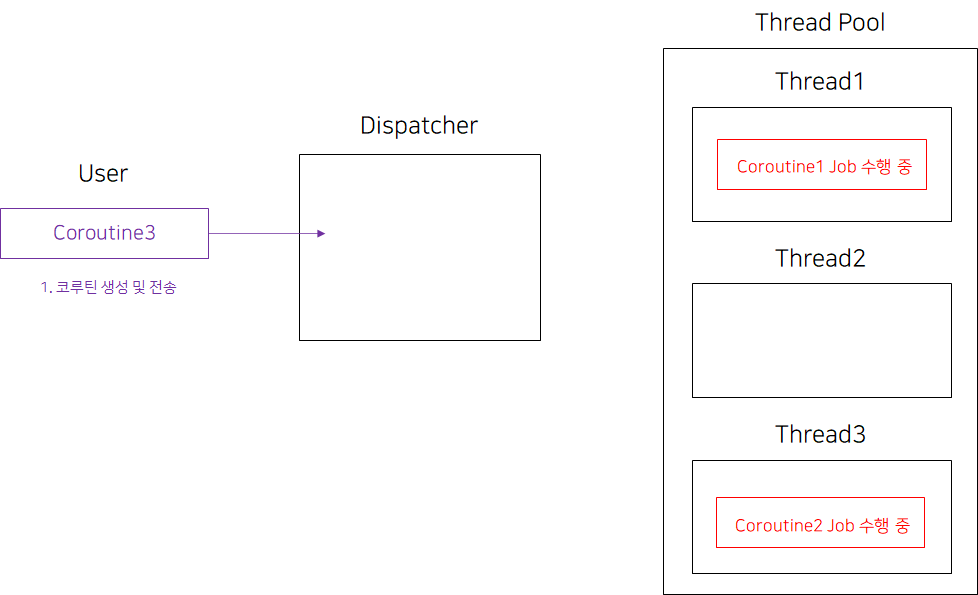
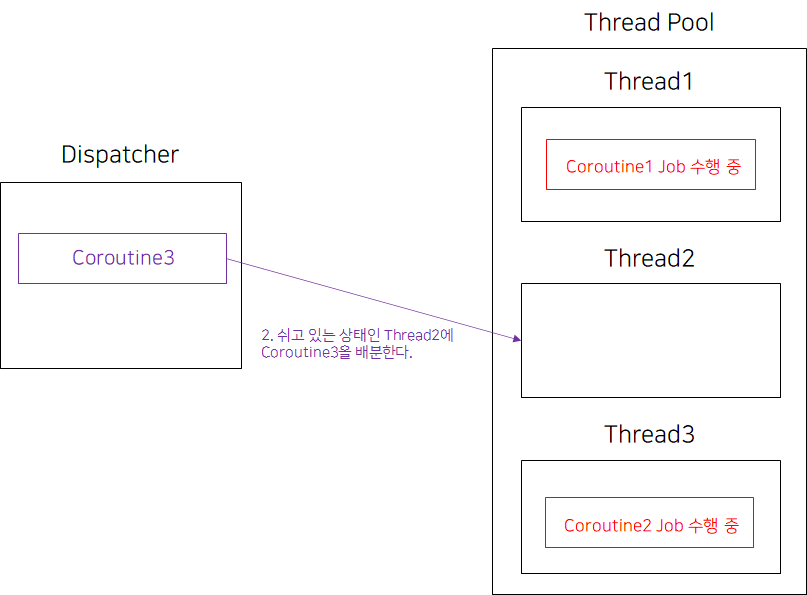
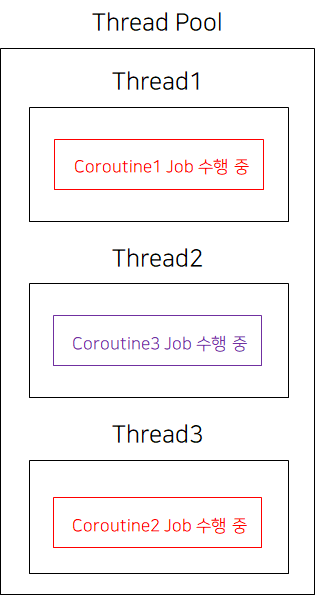
At this time, the CoroutineDispatcher distributes coroutines according to the load situation of the threads within the thread pool. This can be visually represented as follows.
User creates a coroutine and sends it to CoroutineDispatcher
CoroutineDispatcher checks which threads are available in its thread pool, then sends the coroutine to that thread.
The distributed thread executes the coroutine.
This is very similar to the role of ExecutorService in the Executor framework.
Creating a CoroutineDispatcher #
While there are CoroutineDispatchers with an unlimited number of available threads, most CoroutineDispatchers have a limited number of available threads. Let's create a CoroutineDispatcher object with a limited number of available threads.
CoroutineDispatcher that can use multiple threads #
Creating a thread pool in coroutines is easy. You can create a Dispatcher with 3 threads using simple code like this:
val dispatcher = newFixedThreadPoolContext(3, "ThreadPool")
CoroutineDispatcher that can use a single thread #
val dispatcher = newSingleThreadContext("SingleThread")
A Dispatcher is responsible for sending coroutines to threads. When a coroutine is requested for execution in the dispatcher's work queue, if there is an available thread in that CoroutineDispatcher, the coroutine is sent to that thread for execution.
In other words, if we just send a coroutine to a CoroutineDispatcher, the CoroutineDispatcher will send the coroutine to a thread for execution when it has an available thread.
CoroutineDispatcher Basic #
If you configure the coroutine-core or coroutine-android libraries, you can use pre-configured dispatchers, eliminating the need to separately create or define dispatchers using newFixedThreadPoolContext or newSingleThreadContext. The default dispatchers are as follows:
- Dispatchers.Main: This dispatcher is used to execute tasks that interact with the UI. It requires a dependency on the
coroutine-androidlibrary. - Dispatcher.IO: This dispatcher is optimized for Disk or Network I/O operations and can be used with a dependency on the
coroutine-corelibrary. - Dispatcher.Default: This dispatcher is for executing CPU-intensive tasks (CPU Bound), such as sorting or JSON parsing.
Pre-defined dispatchers can be used with launch as follows:
launch(Dispatchers.Main) {
	updateButton() // 필요한 Job 수행
}