Reactive Streams
Reactive Streams #
A standard for asynchronous data processing using non-blocking backpressure.
API #
public interface Publisher<T> {
    public void subscribe(Subscriber<? super T> s);
}

public interface Subscriber<T> {
    public void onSubscribe(Subscription s);
    public void onNext(T t);
    public void onError(Throwable t);
    public void onComplete();
}

public interface Subscription {
    public void request(long n);
    public void cancel();
}
It consists of a simpler set of APIs than one might expect.
How Reactive Streams Work #
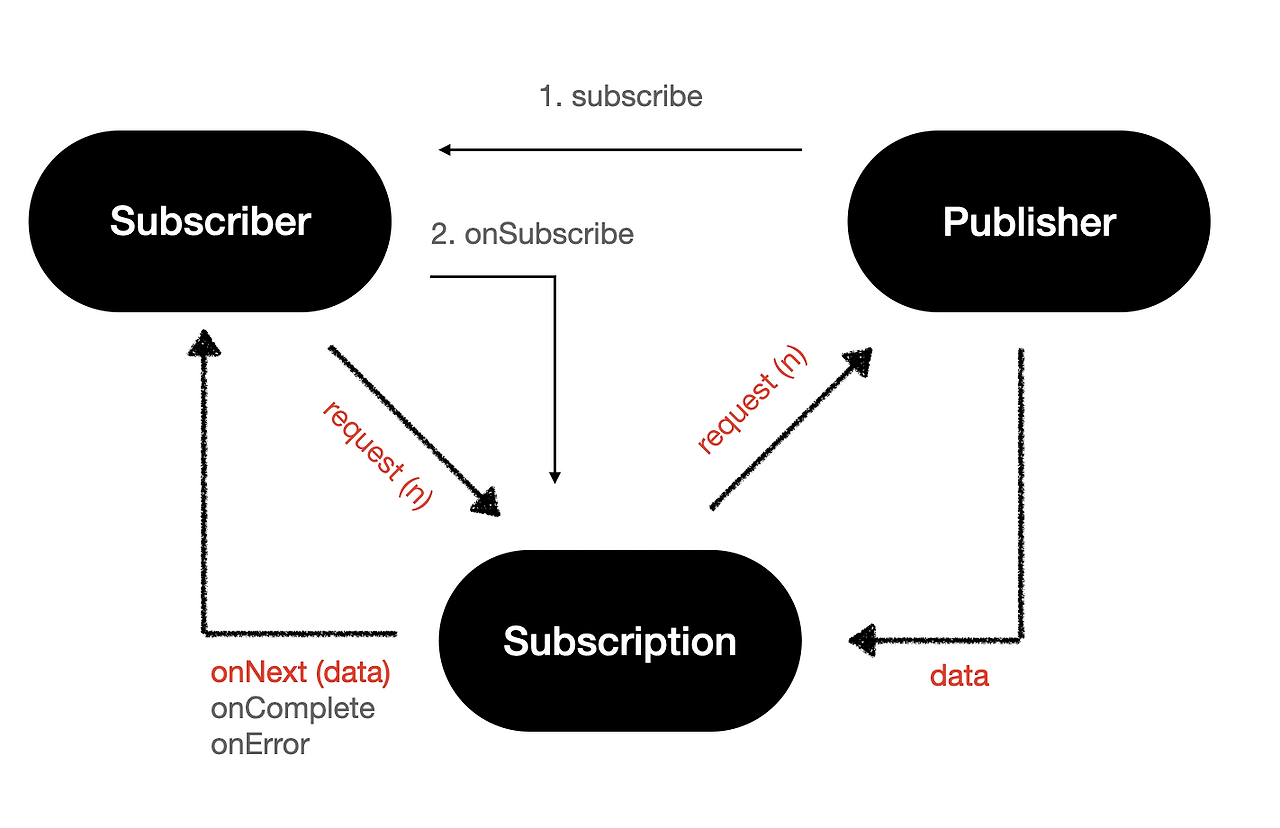
The important thing to note is that the Publisher does not push data to the Subscriber; instead, it's a pull-based approach where the Subscriber requests data from the Publisher, and this method is called backpressure.
Backpressure #
When a Publisher publishes and a Subscriber subscribes, instead of the Publisher pushing data to the Subscriber, the Subscriber requests data from the Publisher in a pull-based manner, asking for an amount it can handle, thereby preventing failures.
In other words, it's a method where the Subscriber requests data through a dynamic pull mechanism, asking for as much as it can accommodate.
Implementation #
public class ReactiveStreamTest {

  public static class PublisherImpl implements Publisher<Integer> {
    @Override
    public void subscribe(Subscriber<? super Integer> subscriber) {

      Queue<Integer> queue = new LinkedList<>();
      IntStream.range(0, 10).forEach(queue::add);

      subscriber.onSubscribe(new Subscription() {
        @Override
        public void request(long n) {
          System.out.println("request:" + n);

          for (int i=0; i<=n; i++){
            if(queue.isEmpty()) {
              subscriber.onComplete();
              return;
            }
            subscriber.onNext(queue.poll());
          }
        }

        @Override
        public void cancel() {
          System.out.println("publish cancel");
        }
      });
    }
  }

  public static class SubscriberImpl implements Subscriber<Integer> {

    private Subscription subscription;
    private long requestSize = 2;
    private List<Integer> buffer = new ArrayList<>();

    @Override
    public void onSubscribe(Subscription s) {
      subscription = s;
      subscription.request(requestSize);
    }

    @Override
    public void onNext(Integer integer) {
      System.out.println("  onNext - " + integer);
      buffer.add(integer);
      if(buffer.size() == requestSize) {
        buffer.clear(); //flush
        subscription.request(requestSize);
      }
    }

    @Override
    public void onError(Throwable t) {
      System.out.println("error:" + t.getMessage());
    }

    @Override
    public void onComplete() {
      System.out.println("subscribe complete");
    }
  }

  public static void main(String[] args) {

    Publisher<Integer> publisher = new PublisherImpl();
    publisher.subscribe(new SubscriberImpl());

  }
}
Result
request:2
  onNext - 0
  onNext - 1
request:2
  onNext - 2
  onNext - 3
request:2
  onNext - 4
  onNext - 5
request:2
  onNext - 6
  onNext - 7
request:2
  onNext - 8
  onNext - 9
request:2
subscribe complete
We limit the request size to 2, and if the data's request size and bufferSize are equal, we clear the buffer and request again from the publisher via the subscription.
It's convenient to think of a subscription as a type of remote control.