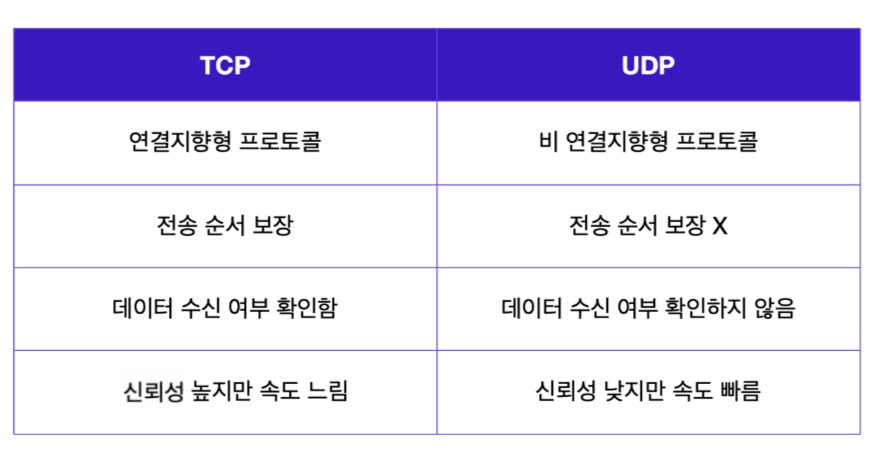
TCP/IP Packet, TCP vs UDP
TCP/IP Packet #
TCP segments include source port, destination port, transmission control, sequence, and verification information, which can supplement the source IP and destination IP information of IP packets.
TCP #
Transmission Control Protocol TCP is a relatively more reliable protocol compared to UDP, which belongs to the same layer.
- Connection-oriented - TCP 3-way handshake (virtual connection)
- Guaranteed data delivery
- Guaranteed order
- Reliable protocol
Connection-oriented - TCP 3-way handshake (virtual connection) #
TCP is a connection-oriented protocol that uses a 3-way handshake to establish a logical connection between devices.
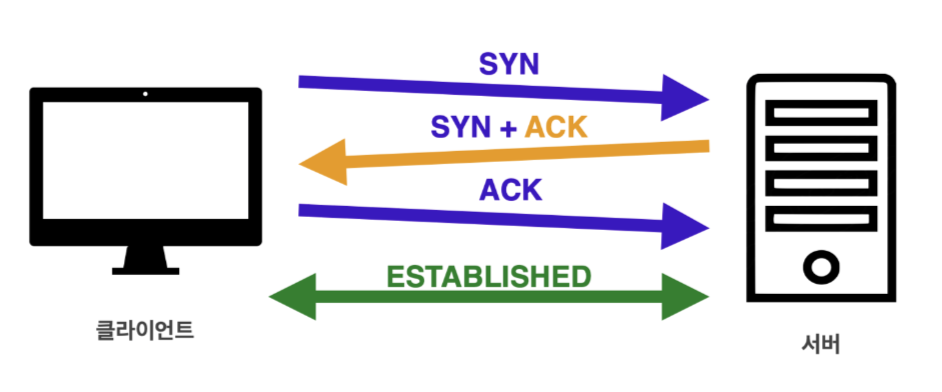
- The client sends a SYN packet requesting a connection to the server.
- The server receives the SYN request, sends a packet with ACK and SYN set, indicating acceptance of the request, and waits for the client to respond with ACK again.
- The client sends an ACK to the server.
- From this point on, the connection is established, and data can be transmitted.
- If the server is off, the client sends a SYN, but since there's no response from the server, no data is sent.
- Currently, due to optimization, data is sometimes sent along with the 3rd ACK.
SYN: Synchronize ACK: Acknowledgement
Guaranteed data delivery #
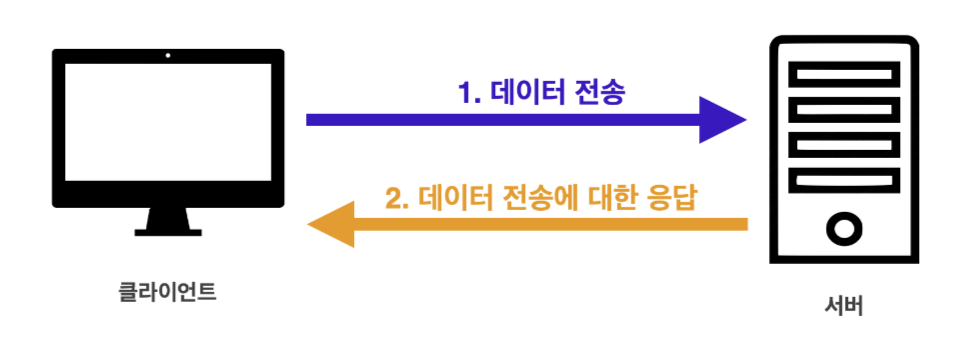
TCP returns a response if data transmission is successful, thereby compensating for the connectionless nature, which is a limitation of IP packets.
Guaranteed order #
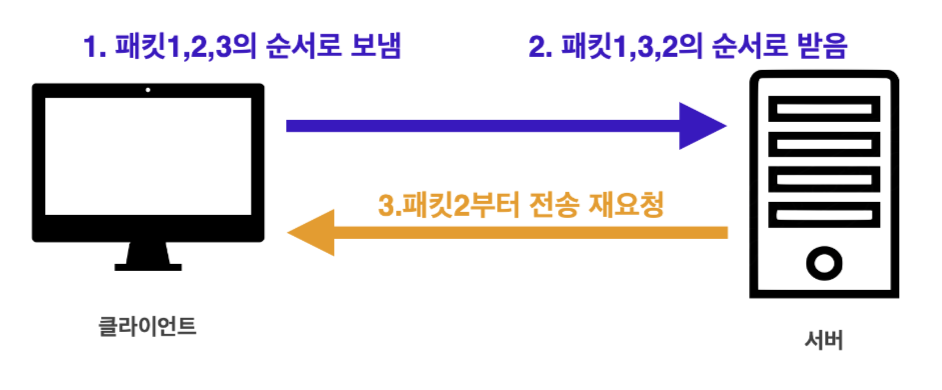
If packets do not arrive in order, a retransmission of packets can be requested based on the information in the TCP segment.
This compensates for the unreliability (no guaranteed order) of IP packets.
UDP #
User Datagram Protocol
UDP is a simple protocol that only adds port and checksum field information to the IP protocol.
- Often compared to a blank canvas (has very few features)
- HTTP3 uses UDP, and its advantage is that it's like a blank canvas, allowing for more customization than TCP, which already has many features implemented.
- Connectionless - no TCP 3-way handshake
- No guaranteed data delivery
- No guaranteed order
- Data delivery and order are not guaranteed, but it is simple and fast.
- Often used in services where continuity is more important than reliability (e.g., real-time streaming).
To illustrate the difference between TCP and UDP, you can compare them to a heavy library with all good features included versus a lightweight library with only essential features.
A checksum is a form of redundancy check, a simple method to protect the integrity of data transmitted over space (telecommunication) or time (storage) through error detection.
TCP vs UDP #